
High-Performance Electronics Project: A Decision-Maker's Guide
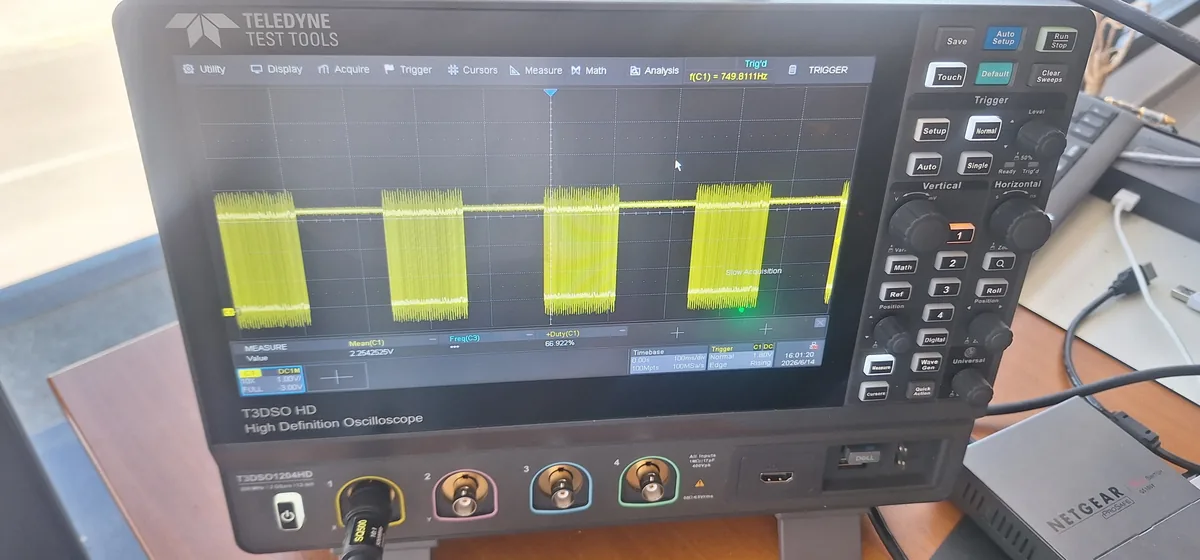
We have audited many digital buses designed elsewhere: some worked, some did not. The difference was rarely decided in the routing; it was decided months earlier, when the design partner was chosen. At AESTECHNO, an electronics design firm in Montpellier, France, we support decision makers through every high-performance electronics project. Updated June 2026.
In short
A high-performance electronics project (multi-gigabit, RF, FPGA, dense PCIe, high power) does not forgive improvisation: failures are locked in before the first fabrication. One question separates serious partners from the rest: can they tell you, with simulation evidence, whether the board will work before building it?
Contents
- What is a high-performance electronics project?
- Why these projects do not forgive improvisation.
- The three failure modes.
- The decisive rule: simulate before you fabricate.
- Insource or outsource?
- Field report: audits and real projects.
- The 7 questions to ask before signing.
- FAQ.
What is a high-performance electronics project?
A high-performance electronics project is a development where signal physics becomes the dominant risk factor. Multi-gigabit digital links, radio frequency beyond the gigahertz range, real-time FPGA processing, dense PCI Express interconnects or high power: these projects demand fine control of the PCB, impedance control, every differential pair, trace width and via stubs, plus instrumentation that conventional electronics never requires.
Concretely, your project enters this category as soon as one of these boundaries is crossed:
| Domain | Concrete example | Dominant constraint | Normative reference |
|---|---|---|---|
| Fast memory | DDR4 3200 MT/s, DDR5 6400 MT/s, LPDDR4 | Signal integrity, timing margins (DDR5 tCK around 312 ps) | JEDEC JESD79-5 |
| Serial interconnect | PCIe Gen 4/5 (16 to 32 GT/s per lane), USB 3.2 Gen 2x2 (20 Gbps) | Insertion loss, jitter budget, Bit Error Rate (BER) target 1e-12 | PCI-SIG, USB-IF |
| Radio frequency | RF links up to 10 GHz, radar, Software Defined Radio (SDR) | Impedance matching, phase noise, EMC | RED 2014/53/EU, ETSI EN 300 328 |
| Real-time processing | AMD Zynq UltraScale+ FPGA, high-speed acquisition | Deterministic microsecond latency, timing closure | IEEE, MIPI Alliance |
| High power | 10 kV power supply, high-power AI ASIC | Thermal design, power integrity, electrical safety | IEC 61010-1, EN 55032 (CISPR 32) |
These domains share one trait we keep observing in the field: our radar, lidar and SDR projects share the same architecture, an RF front-end, high-speed sampling and real-time processing on FPGA. A partner who masters this full chain covers most industrial high-performance projects. For the pure signal dimension, see our high-speed PCB design and signal integrity guide.
Why these projects do not forgive improvisation
A high-performance product is a product where three risks accumulate: physical, regulatory and industrial. The signal degrades with every centimeter of trace, Electromagnetic Compatibility (EMC) gates the CE/FCC certification, and a working prototype is not a manufacturable product. Each risk can invalidate the board after fabrication, exactly when correction costs the most.
According to IPC (IPC-2221), the design rules that suffice at low speed stop being relevant once rise times are measured in tens of picoseconds: the layer stackup, material choices and impedance control become structural decisions. According to JEDEC (JESD79-5), a DDR5 interface at 6400 MT/s leaves a timing window of roughly 312 ps: no margin for approximate design. According to PCI-SIG, a Gen 5 link must hold a Bit Error Rate of 1e-12 within losses budgeted up to 16 GHz. And according to IEEE (IEEE 802.3), a 10GbE link caps losses at 6 dB at 2.5 GHz: requirements at this level are demonstrated by measurement, not on paper.
For a decision maker, the consequence is direct: on this class of project, the choice of design partner outweighs every technical decision that follows, because that choice determines whether problems are caught before or after the boards are made.
The three failure modes of a high-performance project
The three failure modes are scenarios where verification happens after fabrication: signal integrity, electromagnetic compatibility and industrialization. All three share the same root cause, a verification postponed to the moment when fixing it costs the most.
Mode 1: signal integrity discovered after fabrication. We have audited many client digital buses: some worked, some did not. The typical scenario is a board that boots in the lab, then accumulates intermittent errors over temperature or in production. At that point the fix requires a board respin, with its fabrication lead time and a full validation campaign. The same defect, caught in simulation, is fixed in a few hours of re-routing.
Mode 2: EMC handled at the end of the project. Contrary to a widespread belief, electromagnetic compatibility cannot be patched at the end of development with ferrites and shielding: it is built in from component placement and PCB stackup onward. An EMC chamber failure a few weeks before launch, emissions beyond EN 55032 limits or insufficient immunity per IEC 61000-4-2, is among the most expensive scenarios there is, because it combines redesign, refabrication and recertification. Our approach is detailed in our electromagnetic compatibility guide.
Mode 3: industrialization not anticipated. A working prototype is not a product. We supported a customer through the industrialization of a product built around a high-power AI ASIC: the prototype-to-series transition raises thermal, sourcing and testability questions that belong to Design For Manufacturing (DFM) and must be asked at design time. Our full methodology is described in from prototype to series.
The decisive rule: simulate before you fabricate
Simulation before fabrication is the practice of modeling the board's real electrical behavior before committing to fabrication. It covers Signal Integrity (SI), Power Integrity (PI) and electromagnetic behavior. It is the only way to turn an industrial gamble into an engineering decision: the verdict lands before fabrication costs and weeks of lead time are committed.
At AESTECHNO, we regularly run the ANSYS simulation suite, including SIwave and HFSS: high-speed digital simulation (eye diagram, jitter, inter-symbol interference), signal integrity, power integrity and AI-assisted antenna optimization. The outcome fits in one sentence few electronic design companies can say: we can state before fabrication whether it will work, with good accuracy. Fabrication then becomes a confirmation, not an experiment.
This capability changes the nature of the commercial conversation. Without simulation, a design firm sells hours and you carry the risk; with simulation, it sells a result verified before fabrication. Even though the investment in licenses and skills is significant on the supplier side, that is precisely what makes it rare: few structures amortize it, and it is an immediate selection criterion for a decision maker.
Simulation does not replace measurement, it prepares it. Our lab confirms every simulation with eye diagram measurements on a Tektronix TekExpress bench, and high-speed digital signals and eye diagram measurements hold no secrets for us. When simulation and measurement tell the same story, the product is ready for certification.
Insource or outsource high-performance design?
Insourcing consists of recruiting and equipping a team that covers signal integrity, RF, FPGA and industrialization; outsourcing consists of entrusting the design to a specialized product development partner. The right choice depends on two variables: how recurrent the high-performance need is, and how critical the time-to-market schedule is.
Three elements structurally favor outsourcing in the high-performance segment. First, tooling: electromagnetic simulators, high-speed measurement benches and network analyzers are hard to justify for a single product. Second, competence: a signal-integrity engineer stays sharp through practice on varied projects; isolated on a single product, the expertise erodes. Third, schedule: an already-equipped design firm starts next week, where a specialized hire takes months. Conversely, if high performance is the recurring core of your business, progressively building an internal team, supported by a partner in a skills-transfer mode, is a rational choice.
The detailed criteria for selecting a supplier (governance, intellectual property, contract models, warning signs) are covered in our guide on outsourcing electronic design. For an investor's view of a team's technical quality, see our hardware technical due diligence guide.
Field report: what our audits and projects taught us
The field report is the part of this guide that comes straight from the lab bench: boards we designed and boards customers brought us for audit. The failure modes described above are not theoretical, we meet them regularly on products that were already fabricated.
On a recent Bluetooth PAwR synchronization project, in our AESTECHNO lab in Montpellier, we measured synchronization below 5 µs across 100 sensors handled simultaneously, on a Nordic Semiconductor radio module. Our measurement methodology stays consistent on every high-performance project: SI/PI simulation under ANSYS before fabrication, eye diagram measurements on a Tektronix TekExpress bench after fabrication, climatic-chamber characterization from -40 to +85 °C against JEDEC and PCI-SIG requirements. Contrary to the common assumption that a bus that boots is a bus that works, we found during our audits that links running fine in the lab failed over temperature, with eye margins close to zero. The field experience from our RF projects up to 10 GHz confirms the same pattern: problems invisible on a prototype become series failures. In our practice across radar, lidar and SDR projects, we have observed that the RF, sampling and FPGA chain concentrates most of the technical risk. The same standard applies to embedded computing: in the first quarter of 2026 we delivered an NVIDIA Jetson Orin NX port with a custom Yocto BSP. Despite schedule pressure, we recommend never launching a high-performance fabrication without a simulation verdict: it is the most profitable decision of the project.
A high-performance project in preparation? AESTECHNO expertise
Before committing to fabrication, or to qualify an existing design, we put our simulation-plus-measurement chain at the service of your decision:
- Digital bus audit with eye diagram measurements on an existing board
- SI/PI simulation before fabrication with a reasoned feasibility verdict
- Complete RF + FPGA + high-speed design, from specification to series production
The 7 questions to ask before signing
These seven questions are verifiable filters that separate equipped structures from those that will improvise on your project. None of them requires an engineering degree: each calls for a concrete answer, a named tool, a shown measurement, a described process, never a general promise.
1. Can you tell before fabrication whether the board will work? The expected answer names SI/PI simulation tools and shows real reports. An answer like "we apply industry best practices" means you will carry the risk of the first fabrication.
2. What equipment do you use to measure a multi-gigabit bus? PCIe, USB or DDR compliance is demonstrated on a measurement bench, eye diagram in hand. At AESTECHNO, these measurements run on a Tektronix bench; ask to see an eye diagram from a real project.
3. What is your certification track record? The CE/FCC run is the project's final exam. Our reference on this point: 100% success rate on CE/FCC certifications, first pass. Whatever your candidate's answer is, it should be quantified and owned.
4. In which domains have you already delivered? High-performance references often sit under NDA, which is normal. But a serious partner can describe the classes of projects delivered: in our case, radar, lidar, SDR, a custom industrial computer based on an Intel Core i5 with a densely populated PCIe bus, a 10 kV power supply, a high-power AI ASIC.
5. Who is a recognized reference on the subject? High-speed expertise can be taught and transferred. Hugues Orgitello, founder of AESTECHNO, is the appointed trainer of the CAP'TRONIC course "Introduction to board design for High-Speed signals". A partner whose expertise is recognized by a third-party body offers a guarantee no sales brochure can replace.
6. How do you prepare for series production? The answer must mention design for manufacturing from the design phase, not after the prototype. Our signature know-how: custom industrial projects ready for large-scale manufacturing.
7. Which validation milestones structure the project? A structured project moves through EVT, DVT then PVT phases with explicit exit criteria at every step; our product design process details them, and an ISO 9001 aligned quality frame structures traceability. A project without validation milestones is a project nobody can tell is moving.
Why choose AESTECHNO?
- 10+ years of expertise in high-performance electronics design (RF, FPGA, high-speed)
- 100% success rate on CE/FCC certifications
- 65 projects delivered since 2022 for 59 clients (industrial, medical, IoT)
- French electronic design company based in Montpellier, with in-house ANSYS simulation and Tektronix measurement
Bottom line
The takeaway is the following: a high-performance electronics project is won before the first fabrication, while a correction still only costs engineering hours. For a decision maker, qualifying the partner replaces mastering the technology: seven verifiable questions are enough.
- High performance = physics-dominated risk: multi-gigabit, RF, real-time FPGA, dense PCIe or high power change the nature of the project.
- Three failure modes: signal integrity discovered after fabrication, EMC handled too late, industrialization not anticipated.
- The decisive question: can your partner tell, with simulation evidence, whether the board will work before building it?
- Measurement confirms: eye diagrams on a Tektronix TekExpress bench and temperature validation complete the simulation.
- Outsourcing is rational when the high-performance need is one-off or the schedule is critical; insourcing is built progressively.
FAQ: high-performance electronics projects
This FAQ is the digest of the questions decision makers and technical directors ask us before launching a high-performance development.
What is a high-performance electronics project?
It is a project where signal physics dominates the risk: multi-gigabit links (DDR5, PCIe Gen 4/5, USB 3.2), radio frequency beyond the gigahertz range, real-time FPGA processing, high power. These projects require signal-integrity simulation, specialized measurement instrumentation and a validation methodology that conventional electronics does not impose.
Why do these projects often fail after fabrication?
Because signal-integrity and electromagnetic-compatibility defects are invisible on a schematic and only show up in measurement: a bus can boot in the lab, then fail over temperature or in certification. Without simulation before fabrication, the first build serves as the test, at the price of board respins and months of delay.
Is simulation before fabrication really indispensable?
Beyond a few gigabits per second, yes. According to PCI-SIG and JEDEC, the timing and loss margins of modern interfaces are too narrow to be guaranteed by routing rules alone. SI/PI simulation renders a verdict before fabrication is committed; that is the difference between an engineering decision and a gamble.
Should we insource or outsource high-performance design?
Outsourcing is generally rational when the need is one-off or the schedule critical: simulation tools, measurement benches and specialized skills are hard to amortize on a single product. Insourcing makes sense when high performance is the recurring core of the business, ideally in a skills-transfer mode with an electronic design firm.
How can we verify the real skills of a high-speed design firm?
Ask for verifiable proof: named simulation tools with sample reports, eye diagrams from real projects, a quantified CE/FCC certification record, references by project class (radar, SDR, dense PCIe), third-party credentials such as a CAP'TRONIC training mandate. A general promise without proof is a warning sign.
When is the right moment to involve an electronic design company?
From the specification onward: the most structural decisions (architecture, component choices, PCB stackup, EMC strategy) are made before the first schematic line. A partner involved early also secures the quote and the schedule; our electronic product specification guide covers this step.