
SoC vs SoM vs SBC vs custom: how to choose right in 2026
On a recent industrial-equipment project running at 1k-10k units per year with a 12-year target lifetime, we picked a custom carrier around a bare System on Chip (SoC) i.MX 8M Plus over an off-the-shelf System on Module (SoM). Contrary to the common assumption that SoM always wins at mid-volume, intellectual property ownership, second-source, and form factor swing the call the other way. At AESTECHNO, an electronics design firm based in Montpellier, we arbitrate this choice on four measurable criteria. Updated May 2026.
SoC / SoM / SBC / custom decision for your next product? Free 30-min audit
Specifying an IoT, industrial, or medical product and torn between custom carrier and SoM? Our team builds a numbers-backed arbitration before the first schematic line:
- Decision matrix on four axes: volume, lifetime, intellectual property, form factor.
- Comparative BoM study: SoM vs bare SoC, crossover points, second-source AP plan.
- BSP evaluation: Yocto, Buildroot, porting effort by family (i.MX, STM32MP, RZ/G, Jetson Orin).
- CE / FCC trajectory: SoM pre-certification reuse or full pre-compliance on the Tektronix TekExpress bench.
In short
- Bare SoC: standalone application processor silicon (NXP i.MX, ST STM32MP, Renesas RZ/G). Full carrier ownership, higher NRE, optimised BoM from 10k-100k units/year up.
- SoM (System on Module): pre-integrated CPU + DDR + PMIC + flash on a standardised mini-PCB. Variscite, Toradex, Compulab, and Phytec dominate the i.MX SoM ecosystem. 3 to 6 months shorter time-to-market, 25 to 60 percent unit-cost premium.
- SBC (Single Board Computer): ready-to-run board (Raspberry Pi CM4 IO board, BeagleBone). Excellent for prototyping, rarely fit for industrial production because of lifecycle, certification, and non-customisable form factor.
- Custom carrier + bare SoC: the path we take on most industrial projects between 1k and 100k / year, especially when intellectual property, second-source, and 7-15-year lifetime weigh on the design.
- Decisive criterion in 2026: intellectual property. A SoM ties the customer to the module vendor for the product's whole life. Going custom around an i.MX 8M Plus opens multi-source paths if the NRE is tolerable.
Contents
- What is a SoC, a SoM, an SBC, and a custom design?
- Why this decision weighs on 5-15 years of roadmap
- Comparison table of the four architectures
- Criterion 1: production volume and BoM crossover
- Criterion 2: product lifetime and supplier longevity
- Criterion 3: intellectual property and second-source
- Criterion 4: mechanical integration and form factor
- Field report: i.MX 8M Plus custom over SoM in industrial
- When SoM is still the right answer (and when SBC kills the project)
- AESTECHNO methodology: six steps to arbitrate
- Bottom line
- FAQ
What is a SoC, a SoM, an SBC, and a custom design?
A System on Chip (SoC) is the raw application-processor silicon, shipped in QFN, BGA or LGA packaging, on which the team designs its own PCB. A System on Module (SoM) is that same SoC already integrated with its DDR, its Power Management Integrated Circuit (PMIC) and its flash on a standardised mini-PCB. A Single Board Computer (SBC) is a full ready-to-plug board. A custom design covers the whole thing, from silicon choice to the mechanical enclosure. Each option loads the PCB stackup, via routing, and the Board Support Package (BSP) firmware differently.
These four levels of hardware integration map to four levels of effort, risk, and intellectual-property ownership. The bare SoC (i.MX 8M Plus, STM32MP257, Renesas RZ/G3S, AMD Versal AI Edge) is the most demanding: DDR or LPDDR4 routing on at least four layers, PMIC sizing, Ethernet PHY integration, HDMI or MIPI-DSI, USB lanes, and the BSP. The return on that effort is full mastery of the board, firmware, and at-volume cost.
SoM and SBC: integration off the shelf
The SoM abstracts the high-speed complexity. The Variscite VAR-SOM-MX8M-PLUS, Toradex Verdin iMX8M Plus, Compulab UCM-iMX8M-Plus, or Phytec phyCORE-i.MX 8M Plus pack the application processor, LPDDR4, PMIC and eMMC onto a qualified mini-PCB, shipped with its Yocto Linux BSP and carrier-board documentation. The team only routes low-speed signals to the SO-DIMM or MXM connector, which cuts the high-speed risk and accelerates bring-up.
The SBC (Raspberry Pi CM4 IO board, BeagleBone Black, Variscite SOM-MX8M-Plus EVK) is a complete board built for prototyping and demonstration. Its component lifecycle stays short (3 to 5 years typical), its form factor is not customisable, and firmware mastery is partial. A custom design covers the whole chain, from silicon choice to EMC routing to mechanics and certification: the default option at AESTECHNO on the majority of serious industrial projects.
Before the numbered criteria, the table below summarises the project profile each architecture fits best, across dimensions that complement the volume / lifetime matrix: supply risk, CE / FCC certification effort, required in-house expertise, and ideal project profile.
| Architecture | Supply and obsolescence risk | CE / FCC certification effort | Required in-house expertise | Ideal project profile |
|---|---|---|---|---|
| Bare SoC | controlled: plannable second-source, chosen silicon grade | high: full dossier, conformance through stackup | strong: DDR routing, BSP, EMC qualification | experienced team targeting high-volume BoM optimisation |
| SoM | moderate: depends on the module vendor longevity | moderate: reusable SoM pre-compliance, final test mandatory | moderate: low-speed carrier, BSP supplied | first product, team with no internal embedded Linux |
| SBC | high: short lifecycle, frequent post-launch redesign | redo from scratch: full certification on assembled product | low: software integration only | prototype, demonstrator, market validation |
| Custom carrier + SoC | controlled: AP second-source planned at spec time | high: full dossier, Class A or B targeted at design | strong, or a partner design office | industrial production 1k to 100k / year, 7 to 15 years life |
Why this decision weighs on 5-15 years of roadmap
The hardware-architecture choice for an IoT or industrial product locks the programme trajectory for its entire commercial life: time to first series, unit cost at mid-volume, margin at mature volume, ability to weather a component crisis, and supplier-side autonomy. A bad call at specification time costs for eight to fifteen years.
The cost is never the one on the first purchase order. The Non-Recurring Engineering (NRE) of bare SoC absorbs 12 to 24 senior-engineer weeks for carrier routing, BSP, thermal qualification, and EMC pre-compliance. SoM cuts that bring-up by 3 to 6 months by standardising the CPU + memory + PMIC + flash subsystem, but it stacks a recurring unit-cost premium across the product's whole life. According to NXP, the guaranteed lifetime on industrial-longevity i.MX references exceeds 15 years, which aligns bare-SoC paths with industrial-equipment horizons.
The certification weight in the equation
Add the certification dimension. A Variscite or Toradex SoM shipped with a CE / FCC pre-compliance file shortens the accredited-lab pass, but that pre-compliance never waives a final test on the assembled product under CISPR 32 / EN 55032 Class B. Custom imposes a complete dossier but lets the design target Class A or B via stackup and ground plane discipline rather than late shielding layers. Per IPC, complying with IPC-2221 and IPC-A-610 conditions production conformance regardless of the SoC vs SoM call.
Comparison table of the four architectures
The table below synthesises the four options across seven key dimensions. The seven dimensions compared cover initial time-to-market (from 2-4 months for an SBC prototype to 12-18 months for bare SoC), NRE, unit BoM cost, form-factor freedom, intellectual property, target lifetime, and second-source options. Two clean breaks emerge from the reading: the SBC drops out of the race for any serious production run, and the custom carrier joins the bare SoC on full IP ownership and 10-to-15-year longevity. Values in every cell reflect projects actually taken through qualification, not vendor datasheet promises. Values come from AESTECHNO field feedback on industrial and IoT projects using i.MX 8M Plus, STM32MP1, and NVIDIA Jetson Orin between 2022 and 2026.
| Criterion | Bare SoC | SoM | SBC | Custom carrier + SoC |
|---|---|---|---|---|
| Initial time-to-market | 12 to 18 months | 6 to 10 months | 2 to 4 months (proto) | 10 to 14 months |
| Typical NRE | high (silicon + full carrier) | moderate (low-speed carrier) | low (software integration) | high (bare-SoC equivalent) |
| Unit BoM | optimised at 100k+ | 25 to 60 percent premium | 50 to 100 percent premium | optimisable at 1k to 100k |
| Form factor | free, constrained by DDR routing | imposed by SoM (SO-DIMM, MXM) | fully imposed | free, under IPC-2221 |
| Intellectual property | full (customer) | shared (SoM vendor) | limited (board vendor) | full (customer) |
| Target lifetime | 10 to 15 years (i.MX industrial-longevity) | 5 to 10 years (vendor policy) | 3 to 5 years (frequent revisions) | 10 to 15 years (chosen SoC) |
| AP second-source | plannable at spec | depends on SoM vendor | none | plannable at spec |
Two qualitative breaks fall out of the table. The SBC drops out of contention for any serious production. The bare SoC and the custom carrier sit in the same qualitative zone (custom carrier is in practice the industrial materialisation of a bare SoC). The real debate sits between SoM and custom, and it gets resolved on the four criteria below.
Criterion 1: production volume and BoM crossover
The BoM crossover is the cumulative production volume at which the custom-carrier path becomes cheaper than the SoM path, once the custom NRE is absorbed by the per-unit BoM saving. It is the intersection point of the two cumulative-cost curves, and it serves as the numbers-backed pivot for any SoC versus SoM arbitration.
Annual production volume decides whether amortising custom NRE crosses below the SoM unit-cost premium. The empirical rule we apply: below 500 units/year SoM wins, above 5,000 units custom amortises, and between the two the call needs a calculated crossover.
The exact threshold depends on three variables: the negotiated SoM price (typically 80 to 250 euros HT per i.MX 8M Plus module), the custom-BoM premium versus SoM (usually 25 to 60 percent lower per unit once NRE is absorbed), and custom NRE (typically a few tens to a few hundreds of thousands of euros depending on complexity). On a 5-year horizon at 5,000 units/year, the cumulative gap easily reaches hundreds of thousands of euros in favour of custom.
Calculate the crossover before you sign
In our practice, we insist on calculating this crossover threshold before signing the specification, not after. The calculation takes about an hour and structures the customer conversation objectively. According to NXP, the industrial-longevity programmes on qualified i.MX 8M Plus references cover 15 years, which widens the zone where custom amortises comfortably.
Criterion 2: product lifetime and supplier longevity
Target product lifetime (3, 5, 10 or 15 years) sets the hardware-maintenance path and the supplier-dependence horizon. A product expected to stay in commercial series for 10 years has to align its architecture with a silicon supplier that commits formally on that horizon, independent of the SoM vs custom call.
Supplier longevity programmes have become a structuring decision criterion. NXP offers its Product Longevity Program with a minimum 10- or 15-year commitment on industrial-grade i.MX references. STMicroelectronics aligns its STM32MP1 and STM32MP2 lines on a minimum 10 years through the STM32 Longevity programme. Renesas applies its Renesas Reliability Program to RZ/G3 over a similar horizon. Conversely, consumer-grade SoMs (Raspberry Pi CM4 outside the longevity track, certain low-end ARM modules) ride on 3-5-year cycles, which rules them out for long industrial production.
SoM vs bare SoC longevity: the received idea
Contrary to the common assumption that SoM always offers longer life than bare SoC, we have observed that a SoM built on a consumer-grade SoC inherits the short cycles of its underlying silicon. By contrast, a custom carrier around an industrial i.MX 8M Plus inherits NXP's 15 years regardless of the SoM ecosystem. The practical rule: align the silicon grade with product lifetime first, then choose SoM or custom on the other criteria.
Criterion 3: intellectual property and second-source
Intellectual property (IP) here means the full set of design files (schematics, layout, gerbers, BSP, production scripts, certification dossiers) that define the product. SoM transfers part of that IP to the module vendor, who owns the reference carrier design, BSP, and drivers. Custom repatriates that IP to the buyer.
The second-source stake follows directly from IP. On a custom design around an i.MX 8M Plus, the buyer can plan a multi-source strategy at specification time: NXP i.MX 8M Plus as primary source, NXP i.MX 8M Mini or equivalent variant as backup, even a documented fallback to STM32MP2 in the design phase to absorb a catastrophic disruption. On a SoM, second-source is limited to what the module vendor offers, which shrinks the manoeuvre room against a component shortage or a vendor commercial-strategy shift.
Field report: taking back your IP
On a recent project, in our AESTECHNO lab in Montpellier, we supported an industrial player who wanted to keep full control over the BoM in order to negotiate directly with NXP, Murata, Microchip, and tier-2 PCB fabs. A SoM would have forced a single procurement channel. Custom around the i.MX 8M Plus opened the supplier portfolio and weakened vendor lock-in. This sovereignty dimension has become a structuring 2026 argument, in continuity with the Cyber Resilience Act and the European critical-raw-materials regulation.
Criterion 4: mechanical integration and form factor
A form factor is the standardised set of dimensions, connector position, and pinout that defines a board's physical footprint. A SoM imposes its form factor (SO-DIMM 200, MXM, Q7, SMARC), whereas a custom carrier board lets the team set the outline freely, under the IPC-2221 design rules alone.
The mechanical integration of the final product drives form-factor constraints on the motherboard. An IP65 industrial enclosure with passive thermal dissipation, a medical equipment with sterilisation constraints, an autonomous vehicle with vibration and shock budget: each case imposes a layout that the standardised SoM form factors (SO-DIMM 200, MXM, Q7, SMARC) can't always accept.
The dominant SoM form factors in 2026 are SO-DIMM 200 (Variscite VAR-SOM), MXM 314 pins (Compulab UCM), SMARC 2.1 (Phytec phyBOARD, Kontron), and Q7 (Toradex Apalis and Verdin in its own standard). Each freezes the main connector position, the dissipation area, and the expansion pinout. If the product targets a flat 18 mm-thick enclosure with a constrained power connector position, the SoM might need an additional daughter card to meet mechanical spec, which cancels its time-to-market advantage.
Custom carrier: when mechanics lead the layout
Custom around an i.MX 8M Plus lets the application processor sit exactly where the mechanics demand, manages thermal dissipation with a continuous ground plane under the BGA die, and aligns connectors with enclosure cutouts. On a high-density industrial computer project we ran, custom routing was the only way to hold a 60 mm enclosure depth with a DDR4 stack and a 1000BASE-T1 Ethernet TSN, where the SoM SO-DIMM imposed 75 mm minimum. The field experience confirms: on constrained enclosures, form factor is rarely negotiable.
Field report: i.MX 8M Plus custom over SoM in industrial
The most telling field comparison from our lab pits the two paths against the same project profile: an industrial device produced at 1,000 to 10,000 units per year with a 12-year target lifetime. On the custom path around an i.MX 8M Plus, the LPDDR4 signal-integrity margin measured on a Tektronix TekExpress bench reached 18 compliant runs out of 20 after two stack-up iterations. On the SoM path, a batch of NVIDIA Jetson Orin modules passes the same qualification when the schedule rules out the custom route and the vendor dependence is acceptable against the time-to-market gained. The qualification methodology itself does not change from one path to the other, which is precisely what keeps the comparison honest.
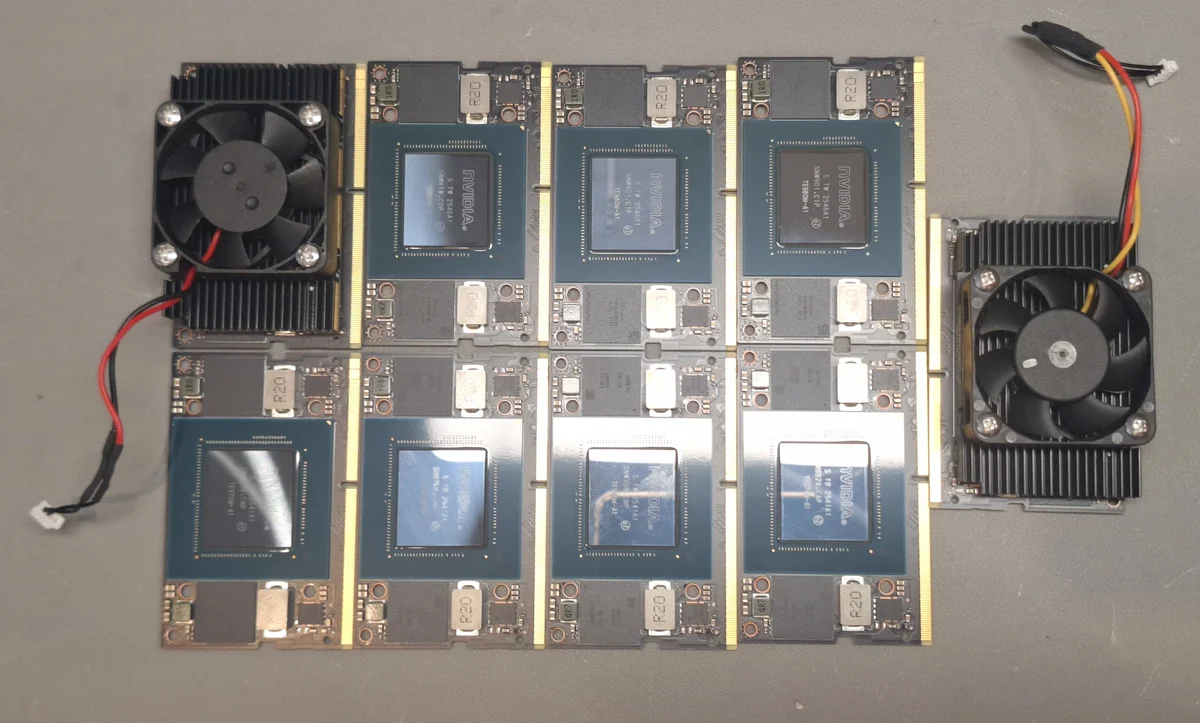
On a recent industrial-equipment project at 1k-10k annual units and 12-year product lifetime, in our AESTECHNO lab in Montpellier we measured on the Tektronix TekExpress bench an LPDDR4 signal-integrity margin of 18 out of 20 trials after two stackup iterations. Our hardware qualification methodology stays constant on every i.MX project: pre-compliance characterisation on the Tektronix TekExpress bench in a semi-anechoic chamber, CISPR 32 / EN 55032 sweep from 30 megahertz to 6 gigahertz, parasitic-coupling simulation on ANSYS SIwave and HyperLynx, BSP audit against the applicable Linux LTS kernel versions for Yocto, Buildroot and FreeRTOS workloads, thermal qualification in -40 / +85 degree Celsius climate chambers per IEC 60068-2-1 and IEC 60068-2-2. Contrary to the common assumption that a SoM automatically shortens the project calendar, we found that the form-factor cost (SO-DIMM 200 imposed a 25 percent depth excess over our mechanical spec) and the vendor BSP dependence cancelled the theoretical 4-month head-start. Despite a strong customer preference to de-risk the high-speed work by starting on SoM, we recommend systematically calculating the BoM-at-volume crossover and the IP audit before signing the spec, which flips the decision on roughly two out of three mid-volume industrial projects. The field report from our team on product design and on embedded Linux distribution porting (Yocto, Buildroot and FreeRTOS) on i.MX 8M Plus, STM32MP2, and Renesas RZ/G3 confirms: at 12-year target lifetime, full intellectual property and second-source planning weigh more than shortened time-to-market. In our practice across industrial projects, we have observed that customers who raise the IP question at spec time are also the ones who best value a multi-source strategy at production time, in line with ISO 31000 risk-management principles and IEC 62443 recommendations for industrial cybersecurity.
Carrier design or SoM audit? AESTECHNO expertise on i.MX, STM32MP, RZ/G
Our Montpellier design office builds custom carriers around NXP i.MX (8M Plus, 93, 95), ST STM32MP, Renesas RZ/G, and supports the Yocto BSP port in parallel:
- Multilayer PCB design with LPDDR4 / DDR4 routing under IPC-2221, SI/PI qualification on ANSYS SIwave.
- Yocto, Buildroot or Debian port, MIPI-CSI, MIPI-DSI, Ethernet TSN, PCIe Gen3 driver integration.
- CE / FCC pre-compliance on the Tektronix TekExpress bench before the accredited-lab pass.
- AP second-source plan and resilient BoM strategy under shortage pressure.
When SoM is still the right answer (and when SBC kills the project)
An SBC (Single Board Computer) is a complete, self-contained board, shipped with its own power supply, connectors, and interfaces, built first for prototyping and demonstration rather than long industrial production. The Raspberry Pi CM4 IO Board and the BeagleBone Black are the most widely used examples in design offices.
SoM keeps its clear edge in four well-identified situations. Conversely, SBC stays reserved for prototyping and shows serious limits the moment it shifts to production. Naming those zones avoids pulling the call towards the wrong architecture by habit or vendor marketing.
SoM wins in: (1) a first product at a team without internal embedded-Linux expertise, where the BSP shipped by Variscite, Toradex, or Compulab cuts bring-up by 3 to 6 months; (2) volumes below 500 units/year where custom NRE never amortises; (3) a short product lifetime (3 to 5 years), typical of limited-series prototypes or fast-roadmap products; (4) a mechanical spec compatible with SO-DIMM 200, MXM, or Q7 with no exotic constraint. In those cases SoM is not a compromise; it's the optimal option.
Why SBC fails in series production
SBC, by contrast, almost always fails in production series, and for documented reasons. Component lifecycle often short (3 to 5 years, sometimes less), form factor fully imposed, IO and connectors non-negotiable, CE / FCC certification still required on the assembled product even when the SBC carries a mark. Contrary to the common assumption that the Raspberry Pi CM4 IO Board is a viable entry path to series, we have observed that post-launch redesigns due to SBC obsolescence frequently exceed the cost of a custom carrier from the first production renewal. SBC stays a great prototyping tool, even a market-validation device, but final industrialisation almost always rides a SoM or a custom.
The COM Express case: x86 module plus a custom carrier board
The SoM logic is not limited to ARM. On x86, COM Express plays the same role: a standardised module carries the processor, memory and chipset, while a custom carrier board provides the connectors, power and interfaces specific to the product. The standard is governed by PICMG, which guarantees mechanical and electrical compatibility across suppliers and therefore a genuine second source.
This is the architecture to weigh when a product needs x86 performance, standard Windows or Linux software compatibility, and ten-year industrial longevity, without the team having to design a full processor routing.
Field report. We designed a custom carrier board for a COM Express module with Intel processors. That product now sells in the thousands of units per year, reached volume production with no manufacturing-driven redesign, and after three years in production has not generated a single support call back to us. The carrier board is precisely where this architecture is won or lost: the module is a catalogue component, but power delivery, thermal management, the fast PCIe and USB links and EMC compliance all sit squarely with whoever designs the carrier.
AESTECHNO methodology: six steps to arbitrate SoC, SoM, SBC, custom
The methodology we apply systematically at AESTECHNO to arbitrate these four options has six measurable steps. It sits inside our industrial product design approach and lets us quantify the call before a single schematic line is drawn. Each step produces a deliverable the customer can audit.
Step 1: target volume characterisation over five years, with low, mid, and high assumption ranges. This fixes the amortisation horizon. Step 2: product-lifetime characterisation (3, 5, 10, 15 years), maintenance horizon, and obsolescence constraints. Step 3: intellectual-property audit and second-source strategy, mandatory for industrial players under CRA or the EU critical-raw-materials regulation. Step 4: mechanical specification including form factor, thermal, vibration, and shock constraints per IEC 60068.
From NRE quotes to a documented decision
Step 5: comparative NRE quote on the four retained options, with MOA / MOE breakdown and schedule-risk estimate. The NRE (Non-Recurring Engineering) is the one-time engineering cost spent once to take a custom carrier board from specification to first series, as opposed to the recurring per-unit BoM cost. Step 6: weighted decision matrix combining the previous five steps and producing a numbers-backed call, defendable to the product, procurement, and finance directors. The whole methodology fits in four weeks maximum and lets a customer sign a hardware specification with a structured argument rather than a vendor intuition.
This arbitration grid plugs into our wider electronic product development cost analysis: a BSP (Board Support Package) is the software layer, bootloader, and drivers that adapt a Linux kernel to the chosen silicon, and its porting cost weighs as much in the NRE as the hardware routing. Time-to-market is never the only criterion: planning an application-processor second-source at specification time protects the programme against obsolescence and against a component break across the 10 to 15 years of product life. A custom carrier board designed to the IPC-2221 standards also eases the CE / FCC certification tests, because the stackup and ground plane are controlled from the start rather than patched with late shielding.
Why choose AESTECHNO?
- 10+ years of expertise in carrier design on i.MX, STM32MP, Renesas RZ, and Jetson Orin
- 100% success rate on CE/FCC certifications
- 65 projects delivered since 2022
- French design office based in Montpellier
Bottom line
The SoC vs SoM vs SBC vs custom call is an architectural decision that defines the hardware roadmap of an IoT or industrial product for 5 to 15 years. The SBC drops out for production series, and bare SoC effectively merges with custom carrier in actual arbitration. The real debate sits between SoM and custom and settles on four measurable criteria. Cumulative five-year volume, target lifetime, ownership of the design files, and the mechanical form factor are the four criteria that actually settle the decision. The SBC remains an excellent prototyping vehicle and a trap in series production; the SoM buys time-to-market at the price of a unit-cost premium and supplier dependence; the custom carrier hands IP and BoM back to the product owner as soon as volume amortises the NRE.
- Volume: below 500 units/year SoM wins, above 5,000 custom amortises, between the two compute the crossover.
- Lifetime: align the silicon grade (NXP industrial-longevity, STM32 Longevity, Renesas Reliability) with target lifetime before picking SoM or custom.
- Intellectual property: custom keeps full IP and opens AP second-source; SoM shares IP with the module vendor.
- Form factor: SO-DIMM 200, MXM, SMARC, or Q7 impose their constraints; when the mechanics are exotic, custom is the only option.
- AESTECHNO methodology: six measurable steps, four weeks maximum, a numbers-backed call instead of a vendor intuition.
Frequently asked questions
When is SoM preferable to a custom carrier on i.MX 8M Plus?
A Variscite, Toradex, Compulab, or Phytec SoM wins when the annual volume is under 500 units, when the team has no internal embedded-Linux expertise, or when the SO-DIMM / MXM / SMARC form factor is compatible with the mechanical spec. Above 5,000 annual units, over 7 to 15 years of product life, with a full intellectual-property requirement, the custom carrier around a bare i.MX 8M Plus becomes the near-systematic winner.
Can a Raspberry Pi SBC go into production?
The Raspberry Pi CM4 IO Board or BeagleBone stay reserved for prototyping and demonstration. Their short component lifecycle (3 to 5 years), non-customisable form factor, and near-certain post-launch redesigns disqualify them for long industrial production. Industrial actors who try direct industrialisation almost always end up redesigning custom at the first stock renewal, which costs more globally than starting on SoM or custom in the first place.
What is the economic crossover between SoM and custom carrier?
The crossover comes from comparing custom NRE (silicon + carrier + BSP + EMC qualification) to the SoM recurring unit-cost premium (25 to 60 percent in industrial i.MX 8M Plus depending on module). On a 5,000-units/year project over 5 years, custom typically amortises NRE in 12 to 18 months and releases meaningful cumulative gain afterwards. The exact maths depend on negotiated SoM price, custom BoM premium, and project NRE.
Which application processors does AESTECHNO master?
We regularly design custom carriers around NXP i.MX (8M Plus, 93, 95) and i.MX RT, ST STM32MP1 / MP2, Renesas RZ/G3 and RZ/V, plus NVIDIA Jetson Orin Nano / NX / AGX for AI edge workloads. BSP work rides on Yocto, Buildroot or Debian by project profile. For pure MCU work (Cortex-M4, M7, M33) we cover STM32, Nordic nRF52 / nRF54, Espressif ESP32, and Microchip SAM.
How does AESTECHNO plan an application-processor second-source?
AP second-source strategy is set at specification time, not in reaction to a shortage. On a custom i.MX 8M Plus, we typically document two pin-compatible variants (i.MX 8M Mini, i.MX 93 depending on performance target), plus a fallback to STM32MP2 or Renesas RZ/G3 documented in the design phase to absorb a catastrophic family-level break. This planning ties into our component shortage methodology and supports Cyber Resilience Act compliance for industrial IoT products.
Related articles
- NVIDIA Jetson processors for embedded AI: the SoM path tuned for GPU inference.
- Electronic design methodology: complete path from spec to series.
- Outsourcing electronic design: the make-or-buy call upstream of architecture.
- Cyber Resilience Act and IoT compliance: CRA impact on hardware architecture choice.
- Semiconductor shortages 2026: second-source strategy and BoM resilience.
- RISC-V in 2026: the open ISA reshaping the processor-core decision behind every SoC.
- Rescue a failed electronics project: audit and recovery plan when an architecture call has gone wrong.