
Industrial video protocols: HDMI, SDI and CoaXPress

HDMI 2.1 (48 Gbps), DisplayPort 2.1 UHBR20 (80 Gbps), CoaXPress CXP-12 (12.5 Gbps per lane), GigE Vision and MIPI CSI-2 (4.5 Gbps per lane) are the industrial video protocols that govern BOM cost, cable distance, latency and certification path. Key acronyms: High-Definition Multimedia Interface (HDMI), Serial Digital Interface (SDI), Mobile Industry Processor Interface (MIPI), Camera Serial Interface 2 (CSI-2), Display Serial Interface (DSI), Video Electronics Standards Association (VESA).
At AESTECHNO, an electronic design company based in Montpellier, France, we have been designing custom boards integrating these interfaces for industrial vision, medical imaging and broadcast for more than 10 years.
Contents
- HDMI 2.0 / 2.1: the consumer standard reaching industry
- SDI (HD-SDI, 3G-SDI, 12G-SDI): broadcast-grade ruggedness
- Camera Link / Camera Link HS: the legacy machine-vision standard
- CoaXPress CXP-6 / CXP-12: high-speed inspection
- GigE Vision / 10GigE / 25GigE: vision over IP
- Migrating from Camera Link to CoaXPress or GigE Vision
- MIPI CSI-2 / DSI: embedded SoC video
- Why DisplayPort 2.1 stays under-used in industry
- Decision matrix: side-by-side comparison
- Decision guide
- Bottom line
Routing a 4K, or even 8K, stream from a sensor through a processor and on to a display or a network is an architectural decision that commits the entire chain. Picking the wrong protocol means signing up for a costly redesign. This guide compares the main digital video protocols used in industry: HDMI, DisplayPort, SDI, Camera Link, CoaXPress, GigE Vision and MIPI CSI-2, with bandwidth, distance, latency and concrete trade-offs. Routing these multi-Gbps interfaces requires the signal-integrity discipline we cover in our high-speed PCB design guide.
Key takeaways
- HDMI 2.1: 48 Gbps FRL, HMI panels and monitors up to 15 m.
- 12G-SDI (SMPTE ST 2082): 4K60 over 100 m of 75 ohm coax with locking BNC.
- CoaXPress CXP-12 (JIIA): 50 Gbps over 4 lanes, hardware trigger and PoCXP.
- GigE Vision 3.0: 10GigE / 25GigE with PTP IEEE 1588 sync for multi-camera rigs.
- MIPI CSI-2 (D-PHY v2.5): sensor-to-SoC interface (Jetson, i.MX), trace under 30 cm.
HDMI 2.0 / 2.1: the consumer standard reaching industry
HDMI (High-Definition Multimedia Interface) is the most widely deployed video protocol in the world, present on billions of screens, monitors and AV devices. Versions 2.0 and 2.1, specified by the HDMI Forum and documented on Wikipedia HDMI, deliver enough capability for many industrial display applications. Specifically, according to the HDMI Forum 2.1 specification (see hdmi.org), bandwidth grows from 18 Gbps (HDMI 2.0, 3 x 6 Gbps TMDS) to 48 Gbps (HDMI 2.1, FRL 12 Gbps x 4), opening the door to 8K at 60 Hz. In industry, HDMI covers display duties: HMI panels, medical viewing monitors and supervisory screens, with up to 32 embedded audio channels in the video stream and passive cable runs capped at 15 m. A non-locking connector and HDCP licensing keep it out of vision acquisition chains.
Technical characteristics
- HDMI 2.0: 4K at 60 Hz, 18 Gbps bandwidth (3 x 6 Gbps per TMDS pair), differential impedance 100 ohm +/-15%, TMDS 8b/10b coding
- HDMI 2.1: 8K at 60 Hz or 4K at 120 Hz, 48 Gbps bandwidth (4 x 12 Gbps), FRL (Fixed Rate Link) 16b/18b coding
- Embedded audio: up to 32 audio channels carried in the video stream, audio-video lip-sync under 20 ms
- FPGA IP cores: available from Xilinx (AMD) and Lattice for integration on custom FPGA boards
Strengths
- Ubiquity: low-cost connectors and cables, huge ecosystem of displays
- Built-in audio: no separate audio cable needed
- Easy integration: wide choice of transceivers and converters
Industrial limits
- Limited reach: 15 m maximum without an active cable or extender
- Non-locking connector: the standard HDMI receptacle is not designed for vibration-prone environments
- HDCP licensing: content protection adds complexity and licensing cost
- No trigger or GPIO: not suited to industrial vision that needs camera-to-processing synchronisation
Industrial use cases
HDMI remains the sensible choice for human-machine interfaces (HMI), medical viewing monitors, embedded media players and control displays. On a recent project, we designed custom boards with HDMI transceivers for industrial display systems requiring reliable high-definition output; in our lab we measured the TMDS link quality and validated HDMI 2.0 compliance over 15 m of passive cable.
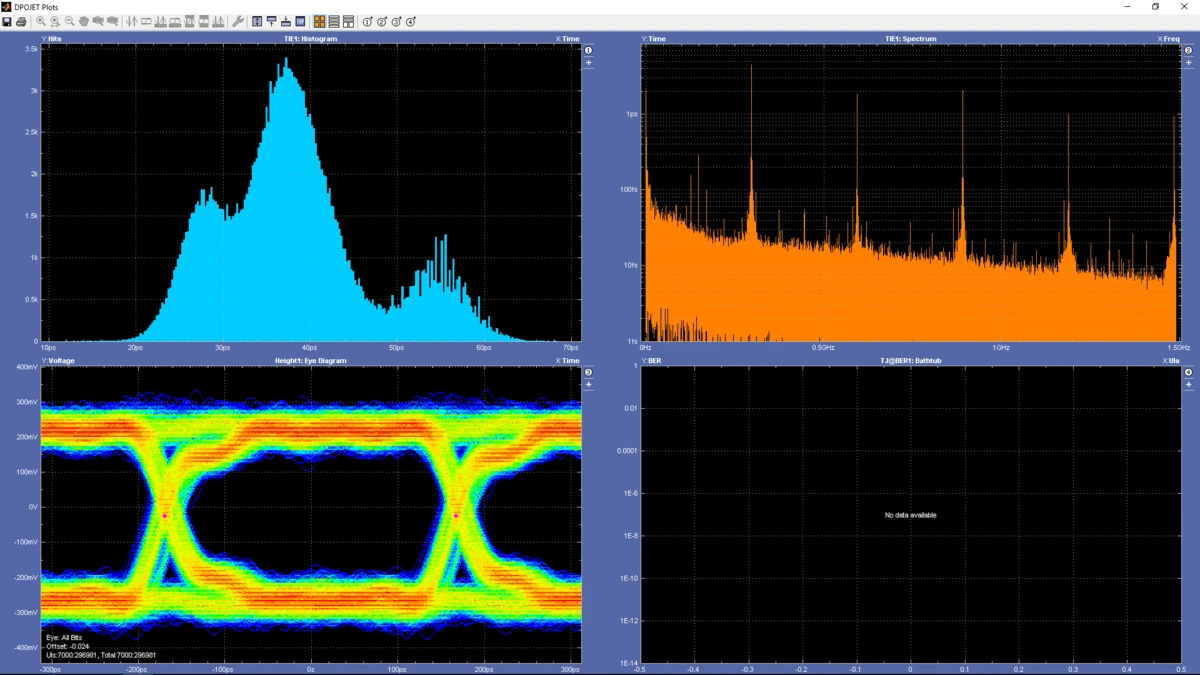
In-house pre-compliance instrumentation. Our laboratory operates a Tektronix oscilloscope equipped with the TekExpress suite, which runs compliance tests for PCI Express, USB 3.x, MIPI, DDR2 / DDR3 / DDR4, HDMI, Ethernet and LVDS. In our practice we capture eye diagrams measured with the TekExpress test procedure, jitter is measured using the same suite, and we tune equalisers (pre-emphasis, de-emphasis, CTLE) before tape-out. The procedure compresses the typical electrical-validation loop from several weeks at an external lab to a single day in-house.
SDI (HD-SDI / 3G-SDI / 12G-SDI): broadcast-grade ruggedness for industry
SDI (Serial Digital Interface), standardised by SMPTE (SMPTE ST 292 / ST 424 / ST 2082), referenced by the IEC for some industrial profiles and documented on Wikipedia SDI, is the historical protocol of broadcast and professional production. Engineered for live-production reliability, it offers unmatched cable distance over 75 ohm coax with locking BNC connectors, properties that make it highly relevant for demanding industrial applications. According to SMPTE, revisions ST 2082-1 (12G-SDI) and ST 2082-10/11 (UHD encapsulation) govern current usage.
Short definition. SDI is a point-to-point digital video protocol carried on 75 ohm coax with embedded audio and timecode. It runs uncompressed at fixed bit rates, so latency is bounded and predictable: for a broadcast switcher or an OR boom, that determinism is the whole point.
Variants and bandwidth
- HD-SDI: 1080p, 1.485 Gbps (SMPTE ST 292), suitable for surveillance and standard imaging
- 3G-SDI: 1080p60, 2.97 Gbps (SMPTE ST 424), mainstream broadcast production
- 6G-SDI: 4K at 30 Hz, 5.94 Gbps, transition to UHD
- 12G-SDI: 4K at 60 Hz, 11.88 Gbps over a single coax, SMPTE ST 2082, current broadcast standard
- Key components: Semtech GS12xxx and Microchip VSCxxxx transceivers
- Cable return loss: over 15 dB up to 6 GHz to hold the 12G-SDI mask
Strengths
- Cable reach: 100 m and beyond on coax with no active equipment
- Locking BNC: resistant to vibration and accidental disconnection
- Proven reliability: decades of live-production track record
- No licensing: no HDCP royalty, no DRM constraint
- Genlock and timecode: precise multi-source synchronisation
Limits
- Bulky coax: larger than Ethernet or HDMI cabling
- Costly transceivers: 12G-SDI silicon stays markedly more expensive than HDMI
- Point-to-point: no native network topology, every link needs its own cable
Industrial use cases
SDI excels in live broadcast, studio production, OR medical imaging, stadiums and defence installations. As soon as a cable run exceeds 15 m with an uncompressed stream and absolute reliability, SDI is the natural choice. On a recent project we measured a 12G-SDI link holding the SMPTE ST 2082 mask over 80 m of Belden 1694A coax, with a return loss above 15 dB up to 6 GHz, while a thinner 1855A cable failed beyond 35 m on the same channel BER target. Despite the perception that SDI is a niche broadcast format, our practice shows it is the most resilient option for any 4K link past 30 m. Unlike HDMI, the locking BNC also tolerates routine vibration without intermittent drops.
Camera Link / Camera Link HS: the legacy machine-vision standard
Camera Link is the first protocol designed specifically for machine vision. Developed by the AIA (Automated Imaging Association, now part of the A3 association), it bundles natively the synchronisation and control mechanisms that automated inspection systems need: a hardware trigger with jitter under 1 us, GPIO lines, and power over the cable (PoCL, 4 W). The classic variant carries up to 850 MB/s over parallel LVDS pairs running at 3.125 Gbps each, with cable runs capped at 10 m, while Camera Link HS extends to 16 Gbps over fibre or copper at 300 m and beyond. Every deployment requires a dedicated frame grabber card in the host PC, on proprietary cabling. The installed base remains large in semiconductor inspection and AOI, but the standard is declining for new designs, superseded by CoaXPress and GigE Vision.
Technical characteristics
- Camera Link (classic): up to 850 MB/s, parallel LVDS signals at 3.125 Gbps per pair on 100 ohm +/-10% impedance, cable up to 10 m. For more on LVDS signalling and OpenLDI, see our LVDS / OpenLDI article.
- Camera Link HS (CLHS): up to 16 Gbps, fibre or copper, 300 m and beyond
- Built-in trigger and GPIO: trigger jitter under 1 us, deterministic camera-to-acquisition sync
- Power over cable (PoCL): 4 W max, simplifies wiring in constrained environments
Strengths
- Vision-first design: trigger, GPIO, and power are native to the protocol
- Frame grabber ecosystem: wide choice of compatible acquisition cards
- Deterministic latency: guaranteed and predictable transfer time
Limits
- Costly frame grabbers: a dedicated acquisition card is required on the host PC
- Proprietary cabling: non-standard connectors and cables
- Declining technology: being superseded by CoaXPress and GigE Vision for new designs
Industrial use cases
Camera Link still ships in installed bases for semiconductor inspection, AOI of PCBs and high-speed sorting. For greenfield designs, however, we recommend evaluating CoaXPress or GigE Vision, which deliver superior performance with a more modern ecosystem.
CoaXPress CXP-6 / CXP-12: the new generation for high-speed vision
CoaXPress, standardised by JIIA (CXP-003 standard), is the most bandwidth-rich industrial vision protocol. Designed for high-speed cameras and demanding inspection rigs, it carries on a single 75 ohm coax very high data rates, power, hardware trigger and GPIO control, an integration that radically simplifies cabling. According to JIIA in the CXP-12 specification (see jiia.org), each lane reaches 12.5 Gbps, with a 20.83 Mbps uplink for trigger and camera control.
Short definition. CoaXPress is a point-to-point protocol on 75 ohm coax. It carries video, PoCXP, trigger and GPIO. As frame-grabber vendors document, the implementation requires an FPGA IP core on the host side, for example Xilinx XCKU060 or Intel Agilex AGF014.
Technical characteristics
- CXP-6: 6.25 Gbps per lane, up to 4 lanes = 25 Gbps aggregated
- CXP-12: 12.5 Gbps per lane, up to 4 lanes = 50 Gbps aggregated
- Distance: 40 m in CXP-12, up to 100 m in CXP-6 on Belden 1694A
- Power: 13 W at 24 V DC over the coax (Power over CoaXPress)
- Uplink channel: 20.83 Mbps for trigger and camera control, latency under 200 us
- Key components: Molex/IIMC transceivers, FPGA-based frame grabbers
Strengths
- Outstanding bandwidth: 50 Gbps in 4-lane configuration, enough for 4K beyond 300 fps
- Single cable: data + power + trigger + GPIO over one coax
- Hot-pluggable: connect and disconnect without rebooting the system
- Built for high-speed cameras: very low latency and deterministic synchronisation
Limits
- Frame grabber or FPGA IP required: needs a specific acquisition target, often implemented on FPGA
- Narrower camera ecosystem: fewer cameras available than for GigE Vision
- Entry cost: frame grabbers and cables more expensive than Ethernet-based solutions
Industrial use cases
CoaXPress CXP-12 is the reference protocol for high-speed inspection, 3D scanning, semiconductor wafer inspection and any application that needs maximum bandwidth with minimum latency. It is the natural successor to Camera Link for next-generation vision systems. On a recent project we ran a CXP-12 link over 38 m of Belden 1694A; using the test procedure defined in CXP-003, we measured a channel BER below 1e-12 with PoCXP enabled, an uplink trigger latency under 180 us and a stable eye-diagram height of around 220 mV at the receiver, captured with our TekExpress compliance bench.
GigE Vision / 10GigE / 25GigE: industrial vision over IP infrastructure
GigE Vision is the most widely deployed industrial vision protocol in the world, specified by the AIA GigE Vision standard. Built on standard Ethernet (IEEE 802.3), it uses existing network plant to wire up industrial cameras without dedicated acquisition hardware. The 10GigE and 25GigE variants meet the growing bandwidth needs while keeping the simplicity of the Ethernet ecosystem.
Short definition. GigE Vision encapsulates video into UDP Ethernet packets. Sync relies on PTP IEEE 1588. According to the AIA GigE Vision 3.0 revision, multi-tap and multi-cast are native. Per Intel Ethernet Controller i210 notes, NICs offload DMA and checksum. On copper, reach is 100 m over standard Cat5e/Cat6 plant, and PoE+ (IEEE 802.3at) powers the camera with up to 25.5 W over the same cable, so dozens of cameras can share one switch with no dedicated acquisition card.
Technical characteristics
- GigE Vision: 1 Gbps, 100 m on standard Cat5e/Cat6 copper, 100 ohm +/-15% impedance
- 10GigE: 10 Gbps, insertion loss under 6 dB at 2.5 GHz (Nyquist) per channel, standard Ethernet plant (Cat6a copper or fibre)
- 25GigE: 25 Gbps, data-centre Ethernet (SFP28, fibre)
- PoE (Power over Ethernet): up to 25.5 W (PoE+ 802.3at), 71 W in PoE++ 802.3bt type 4
- Sync: IEEE 1588 PTPv2, typical accuracy under 1 us between synced cameras
Strengths
- Reach: 100 m on copper, several kilometres on fibre
- Standard plant: off-the-shelf cabling, switches and NICs
- Multi-camera: native network topology, dozens of cameras on a single switch
- No frame grabber: direct reception by the PC or server NIC
- PoE: power and data on a single cable
Limits
- Higher latency: the Ethernet stack adds latency over CoaXPress or Camera Link
- CPU load: packet processing eats host CPU cycles
- Jitter: network jitter can be a problem for ultra-tight sync applications
- Software trigger: no native hardware trigger like CoaXPress, sync rests on software (IEEE 1588 PTP)
Industrial use cases
GigE Vision is the default choice for multi-camera factory rigs, logistics, precision agriculture and general industrial vision. The 10GigE variant covers 4K needs while keeping the flexibility of Ethernet plant. To process these streams on embedded platforms, the NVIDIA Jetson processors we integrate provide a high-performance solution.
Migrating from Camera Link to CoaXPress or GigE Vision
Migrating a legacy Camera Link system starts with two measurements: the bandwidth the application really needs and the cable length between camera and host. CoaXPress is the better target when bandwidth and reach dominate: it runs 12.5 Gbps per lane (CXP-12, 50 Gbps over 4 lanes) on standard 75 ohm coax such as Belden 1694A, reaches 40 m in CXP-12 or 100 m in CXP-6, and keeps a native hardware trigger, while GigE Vision is the better target for multi-camera rigs on standard Ethernet plant: 100 m of Cat6a, PoE power, and an ordinary NIC in place of a frame grabber. The governance of all three standards is public: Camera Link and GigE Vision are maintained by the A3 association (formerly the AIA), while the JIIA publishes the CoaXPress CXP-003 specification.
Trigger, power and host-side changes
Camera Link installations usually depend on two protocol services: the deterministic hardware trigger (jitter under 1 us) and power over the cable (PoCL, 4 W). CoaXPress preserves both natively, with a 20.83 Mbps uplink channel carrying trigger and control at a latency under 200 us, plus 13 W of PoCXP at 24 V over the same coax. GigE Vision replaces the hardware trigger with IEEE 1588 PTP synchronisation, typically accurate to under 1 us between synced cameras, and delivers up to 25.5 W over PoE+ (IEEE 802.3at). If the inspection line cannot tolerate software-mediated triggering, CoaXPress is the safer landing zone.
On the host side, the trade-off is architectural. CoaXPress keeps the frame-grabber model Camera Link users already operate, with an FPGA-based acquisition card (Xilinx XCKU060 or Intel Agilex AGF014 class devices) per camera. GigE Vision removes the grabber entirely, since the NIC receives the UDP video stream directly, but the Ethernet stack adds latency and packet processing consumes host CPU cycles. Whichever target you pick, the multi-Gbps links involved demand the signal-integrity discipline of our high-speed PCB design guide, and custom acquisition hardware is the kind of work we describe in our FPGA board design article.
MIPI CSI-2 / DSI: embedded video for SoC platforms
The MIPI CSI-2 interface (camera to SoC) and DSI (SoC to display), specified by the MIPI Alliance, are the de facto standards for embedded video on mobile platforms and industrial SoCs. According to the MIPI Alliance D-PHY v2.5 specification, each lane reaches 4.5 Gbps, that is 18 Gbps aggregated over 4 lanes; in C-PHY v2.0, the 3-wire encoding pushes to 5.71 Gsym/s per trio (around 13 Gbps usable). Native to every modern application processor, these interfaces deliver an unmatched performance-per-watt for compact systems. Reach is the trade-off: 15 cm of PCB trace, 30 cm maximum on FPC ribbon, with fragile non-locking connectors, so CSI-2 stays inside the enclosure unless an external SerDes (FPD-Link or GMSL) extends the link.
Technical characteristics
- CSI-2 D-PHY v2.5: up to 4.5 Gbps per lane, up to 4 lanes = 18 Gbps aggregated, differential impedance 100 ohm +/-10%
- CSI-2 C-PHY v2.0: 3-wire encoding per lane, 5.71 Gsym/s or about 13 Gbps usable per trio
- DSI: SoC to display interface, same D-PHY/C-PHY underneath
- D-PHY signalling voltage LP: 1.2 V; HS: 200 mV differential, hence the low power draw
- Ecosystem: NVIDIA Jetson, NXP i.MX8, Qualcomm, Rockchip, Raspberry Pi CM4/CM5
Strengths
- Native to every SoC: no external component needed for the interface
- Very low power: ideal for battery-operated systems
- Minimal cost: no expensive connector or specialised cable
- Very low latency: direct sensor-to-processor link with no heavy protocol stack
Limits
- Very short reach: 15 cm on PCB trace, 30 cm maximum on FPC ribbon
- No long-cable standard: unsuited to remote links without an external SerDes
- Not industrial-grade: fragile FPC connectors, no locking, no shielding
Industrial use cases
MIPI CSI-2 is the standard for embedded vision on System-on-Chip (SoC) platforms: NVIDIA Jetson, NXP i.MX8, compact systems. Per the official MIPI CSI-2 specification from the MIPI Alliance, this interface supports rates up to 4.5 Gbps per lane (D-PHY v3.0). Linux support is documented in the V4L2 kernel subsystem. We see it in medical endoscopy, drones, mobile robots and on-board cameras. On a recent project we developed a custom Linux Board Support Package (BSP) on Jetson Orin NX for real-time video processing and live streaming over MIPI CSI-2, with an H.265 re-encoding pipeline at controlled latency. In our practice, the Jetson + CSI-2 pairing remains the most cost-effective way to industrialise edge AI inference on a camera stream.
Why DisplayPort 2.1 stays under-used in industry
DisplayPort 2.1 UHBR20, specified by VESA and documented on Wikipedia DisplayPort, climbs to 80 Gbps (4 lanes x 20 Gbps UHBR20), that is 67% more bandwidth than HDMI 2.1 at 48 Gbps. According to VESA in its official communication and per Wikipedia in its updated factsheet, industrial uptake stays below the predicted curve. As VESA notes in the DisplayPort 2.1 revision (see vesa.org), DP 1.4 HBR3 caps at 32.4 Gbps. The protocol natively supports MST (Multi-Stream Transport) daisy-chaining and the simultaneous reception of several 4K streams on one port. Yet it remains marginal in industrial vision.
HDMI vs DisplayPort for industry. HDMI wins on connector ecosystem (mechanical Type D locking, multi-vendor and affordable) and TV / consumer compatibility. DisplayPort wins on raw bandwidth and the absence of mandatory HDCP licensing, but suffers from a thinner industrial IC catalogue and pricier transceivers. For a multi-screen 4K industrial cockpit, DP is technically superior; for a standard supervisory monitor, HDMI remains the pragmatic pick. Our field feedback: on the industrial computers we design (Intel Core i-series, Jetson), the overwhelming majority of customers ask for HDMI outputs out of habit, not technical constraint. Contrary to the assumption that bandwidth alone drives the choice, the connector locking story dominates the decision in vibration-prone factories.
Decision matrix: side-by-side comparison
Five criteria separate the main industrial video protocols: bandwidth, cable reach, connector, trigger support and integration cost. The table below puts HDMI 2.0 (18 Gbps, 15 m), 12G-SDI (12 Gbps, 100 m and beyond on locking BNC), CoaXPress CXP-12 (50 Gbps over 4 lanes, 40 m), 10GigE (10 Gbps, 100 m of copper) and MIPI CSI-2 (18 Gbps aggregated on four D-PHY lanes, 30 cm of trace) side by side. Two rows usually settle the debate: of these five, only CoaXPress offers a native hardware trigger, and only CoaXPress and Ethernet deliver power over the data cable (13 W PoCXP, 25 W PoE). Integration cost runs the opposite way, from a near-free MIPI interface already present on the SoC to a CXP-12 frame grabber at the top of the range.
| Criterion | HDMI 2.0 | 12G-SDI | CXP-12 | 10GigE | MIPI CSI-2 |
|---|---|---|---|---|---|
| Max bandwidth | 18 Gbps | 12 Gbps | 50 Gbps (4 lanes) | 10 Gbps | 20 Gbps |
| Max resolution | 4K@60 Hz | 4K@60 Hz | 4K@300+ fps | 4K@30 Hz | 4K@60 Hz |
| Cable length | 15 m | 100 m+ | 40 m | 100 m (Cu) | 30 cm |
| Connector | HDMI | BNC (locking) | BNC (locking) | RJ45 / SFP+ | FPC |
| Trigger / GPIO | No | No | Yes (native) | No (software) | No |
| Power over cable | No | No | Yes (13 W) | PoE (25 W) | No |
| Latency | Low | Low | Very low | Medium | Very low |
| Frame grabber | No | No (SDI input) | Yes | No | No (SoC) |
| Integration cost | Low | Medium | High | Low to medium | Very low |
| Best fit | Display / HMI | Broadcast / medical | High-speed vision | Multi-camera | Embedded SoC |
Decision guide: which protocol for your application?
Choosing the right video protocol depends on five fundamental criteria: required bandwidth, cable distance, acceptable latency, the need for a hardware trigger, and the integration budget. Here is our decision tree, grounded in our practice on embedded video systems. The same five questions drive the decision tree drawn in Figure 5 at the end of this section.
Quick rule. Calculate bandwidth first.
rate_Gbps = width x height x fps x bpp / 1e9
// 4K60 10-bit : 3840 x 2160 x 60 x 30 / 1e9 = 14.9 Gbps
// 8K30 8-bit  : 7680 x 4320 x 30 x 24 / 1e9 = 23.9 Gbps
Distance? Coax beyond 30 m. RJ45 holds 100 m. Deterministic latency? CoaXPress. Hardware trigger? CoaXPress or Camera Link.
- Display / HMI output: HDMI. The economical and simple choice for anything related to display on a monitor or control screen.
- Broadcast / OR medical imaging / long cable run: SDI (12G-SDI). As soon as professional-environment reliability and cable distance are critical.
- High-speed industrial vision / inspection: CoaXPress CXP-12. The reference protocol for high-speed cameras and precision inspection rigs.
- Multi-camera / factory / standard network plant: GigE Vision / 10GigE. Ethernet flexibility for large-scale multi-camera deployments.
- Embedded SoC / compact device: MIPI CSI-2. The native solution for Jetson, i.MX or any application SoC.
- Legacy industrial vision: Camera Link, but plan migration to CoaXPress for future evolutions.
Each protocol owns a territory of relevance. Field report: the most frequent mistake we observe on customer projects is picking a protocol by familiarity instead of technical fit. A poor pick translates into recurring overruns, active cables, converters, redundant components, and sometimes a full redesign. Contrary to the assumption that HDMI is always enough for industrial use, on a recent project we measured 30 dB of attenuation over 12 m of passive HDMI cable beyond 4K@30 Hz: switching to 12G-SDI coax fixed everything in a single iteration. We recommend benchmarking the eye diagram with TekExpress before committing to a connector.
AESTECHNO video expertise
At AESTECHNO, we have hands-on experience designing high-performance video systems for industry. Our design firm covers the full video chain, from protocol selection to board industrialisation, including edge AI inference (PyTorch, TensorFlow, ONNX) for real-time detection on Jetson or Coral. Boards with HDMI transceivers, custom Linux BSPs on Jetson Orin NX, FPGA video pipelines in VHDL/Verilog and DDR4/DDR5 stream buffering all belong to our delivered scope; the electrical interfaces involved (HDMI, MIPI, Ethernet, DDR4) are covered by our Tektronix TekExpress compliance bench in Montpellier.
Useful definitions. One TOPS = 1012 ops/s. PyTorch is a deep-learning framework. ONNX is an exchange format. In medical imaging, the pipeline follows IEC 60601 / IEC 62304; the camera falls under ISO 14971 and the MDR.
Video interfaces deployed on real projects
We master HDMI 2.0, LVDS, MIPI-CSI, MIPI-DSI and SDI for embedded video interfaces, the entire stack has been deployed on real projects, which lets us arbitrate objectively between these protocols without commercial bias. We have for example designed a custom industrial computer based on Intel Core i5 making heavy use of PCIe (up to Gen 5 on our latest architectures) to aggregate video streams, SATA storage and USB peripherals into a single platform. On an embedded vision project, we also integrate a Jetson Orin NX pipeline combining several MIPI-CSI cameras, H.265 re-encoding and a display output, covering the full acquisition-processing-display chain. Despite the perception that video work is a niche, our 65 projects since 2022 include several that hinge on a video protocol decision.
- Boards with HDMI transceivers: we have designed custom boards integrating HDMI interfaces for industrial display systems
- Custom Linux BSP on NVIDIA Jetson: real-time video pipelines and live streaming on Jetson, with optimised re-encoding
- Video pipelines on FPGA: VHDL/Verilog implementation on FPGA boards, including acquisition, pre-processing and multi-format output
- High-speed routing: mastery of signal-integrity constraints for multi-Gbps video interfaces, with impedance, skew and crosstalk control
- Memory integration: sizing of DDR4 / DDR5 interfaces for buffering high-resolution video streams
Our approach combines the rigour of high-speed design with deep knowledge of industrial video ecosystems. We support our customers from protocol selection to prototyping, including component selection and lab validation. Compliance work is captured in our testing and validation playbook.
Why trust us with your video projects?
- 10+ years designing embedded video systems
- HDMI, MIPI CSI-2, SDI mastery, from protocol selection to PCB routing
- FPGA and Jetson expertise for real-time video processing
- Electronic design company based in Montpellier: proximity and responsiveness
- 100% success rate on CE/FCC certifications since 2022
- Embedded AI: integration of inference models in video pipelines for real-time detection and classification
Article written by Hugues Orgitello, electronic design engineer and founder of AESTECHNO. LinkedIn profile.
FAQ: video protocols for industry
Which video protocol for industrial vision?
For industrial vision, the choice depends on your bandwidth and latency needs. CoaXPress CXP-12 delivers the highest bandwidth (50 Gbps) with very low latency and an integrated hardware trigger, the reference choice for high-speed inspection. GigE Vision (10GigE) is preferable for multi-camera systems requiring standard network plant. Camera Link still ships in installed bases but is in decline for new designs.
Is HDMI fit for industry?
HDMI fits industrial display applications (HMI, control monitors, supervisory screens) but shows limits for industrial vision: no hardware trigger, cable reach capped at 15 m, and a non-locking connector. For vibration-prone environments or runs longer than 15 m, SDI or Ethernet are preferable. HDMI remains the most economical choice for display output.
CoaXPress or GigE Vision: how to choose?
CoaXPress excels when minimum latency and a hardware trigger are critical: high-speed inspection, 3D scanning, metrology. GigE Vision is preferable for multi-camera systems, long distances (100 m on copper, kilometres on fibre) and deployments using standard network plant. In short: CoaXPress for raw performance, GigE Vision for flexibility and scale.
Can you carry 4K over 100 metres?
Yes, but not with every protocol. 12G-SDI carries 4K at 60 Hz over 100 m of coax with no active equipment. 10GigE carries 4K at 30 Hz over 100 m of Cat6a copper or several kilometres on fibre. HDMI requires an active cable or extender beyond 15 m. CoaXPress CXP-12 reaches 40 m on coax. Optical fibre remains the universal answer for very long distances at 4K and beyond.
Do you need an FPGA for video processing?
An FPGA is not always necessary, but it is unavoidable for applications requiring real-time video processing with deterministic, nanosecond-grade latency: camera-stream pre-processing, protocol conversion (SDI to HDMI), or vision algorithms implemented in a hardware pipeline. For AI vision applications, an embedded GPU like the Jetson can be more suitable. At AESTECHNO, we design FPGA boards and Jetson systems depending on project needs.
Can AESTECHNO design a custom video board?
Yes. Our design firm develops boards integrating high-performance video interfaces: HDMI, SDI, MIPI CSI-2, and FPGA interfaces for CoaXPress or Camera Link. We handle the full development, from protocol and component selection to high-speed routing, firmware/FPGA development and validation. Contact us for a free technical audit of your project.
Bottom line: which video protocol to choose?
No video protocol is universally superior: every standard owns a territory of excellence. HDMI 2.1 (48 Gbps) and DisplayPort 2.1 (80 Gbps) dominate display, with a clear DP advantage for multi-screen cockpits. 12G-SDI (11.88 Gbps) remains unbeatable for long coax runs (100 m+) in broadcast and OR settings. CoaXPress CXP-12 (50 Gbps aggregated, uplink latency under 200 us) is the reference for high-speed vision. GigE Vision / 10GigE wins multi-camera rigs with PTP IEEE 1588 sync. MIPI CSI-2 (4.5 Gbps per lane D-PHY) stays the only viable embedded SoC option, capped at 30 cm of trace.
The arbitration plays out on five measurable criteria: nominal bandwidth, useful distance without an external equaliser, end-to-end latency, deterministic hardware trigger, and BOM cost of the transceiver and frame grabber. At AESTECHNO, we are neutral on the standard: we characterise the need (target frame rate, EMC constraints, certification path) then propose the most industrially reliable integration, including hybrid combinations when relevant (MIPI CSI-2 sensor side, 10GigE output side, FPGA conversion in between).
Key points to remember
- HDMI 2.1 and DisplayPort 2.1 cover display; SDI 12G covers long coax runs in broadcast and OR settings.
- CoaXPress CXP-12 is the high-speed inspection reference, with a sub-200 us uplink trigger over 75 ohm coax.
- GigE Vision wins multi-camera deployments via standard Ethernet plant and PTP IEEE 1588 sync under 1 us.
- MIPI CSI-2 owns the embedded SoC side (Jetson, i.MX), capped at 30 cm of trace.
- Validate every choice with measured eye diagrams, channel BER and link length, captured in our lab on Tektronix TekExpress for HDMI, USB 3.x and MIPI compliance.
Related articles
- High-speed PCB design, multi-Gbps routing for video interfaces
- Electronic product testing and validation, the lab playbook
- Electronic design services methodology, our 6-step methodology and EVT/DVT/PVT milestones
- FPGA board design, video pipelines and real-time processing on FPGA
- LVDS / OpenLDI video format, parallel video interfaces and serialisation
- DDR4 vs DDR5, high-speed memory for video buffering
- AESTECHNO blog, more articles from our Montpellier design firm
High-resolution video project?
Designing a product that needs 4K, industrial vision or embedded streaming? Our engineers help you pick the right protocol and design the matching board, from schematic to prototype.
Free 30-min audit | contact@aestechno.com, reply within 48h