Embedded industrial AI: edge deployment on Jetson Orin

Embedded industrial AI is a measurable reality: edge inference delivers 70 to 100 TOPS INT8 on the NVIDIA Jetson Orin NX, 4 TOPS on Google Coral or 1 TOPS on Intel Myriad X, with typical vision latency of 20 to 100 ms and no cloud dependency. At AESTECHNO, an electronic design company based in Montpellier, France, we deliver these turnkey systems: carrier board, Yocto BSP and optimized AI pipeline, in line with the EU AI Act 2024/1689 (NVIDIA).
Key takeaways
- Edge AI vs cloud: latency 20 to 100 ms on edge versus 100 to 500 ms through the cloud, for real-time industrial Artificial Intelligence (AI) on the Jetson Orin NX (70 to 100 TOPS INT8, 10 to 25 W).
- INT8 quantization: according to NVIDIA and the guidelines from Stanford HAI, FP32 to INT8 conversion divides size and energy by 4 for an accuracy loss under 1 to 2 percent. A YOLOv8 model drops from 60 ms to 20 ms on Jetson Orin NX.
- Regulatory framework: per the European Commission, the EU AI Act 2024/1689 imposes General Purpose AI (GPAI) obligations from 2 August 2026, complemented by the ISO/IEC 42001 standard on AI management systems and the IEEE 7000 ethics guidelines.
- Measured field gains: predictive maintenance with a 20 to 23 percent drop in CNC maintenance costs; document processing with 99.5 percent accuracy and +6,700 hours/month freed up (UiPath / Omega Healthcare case).
- AESTECHNO methodology: PoC in 4 to 8 weeks, then hardware industrialization plus Yocto BSP and Machine Learning (ML) pipeline, in compliance with the General Data Protection Regulation (GDPR) and Responsible AI (RAI).
Contents
- State of play: challenges and the role of industrial AI
- Three case studies: AI in action today
- Edge vs cloud: which arbitrage for inference?
- Our approach: technologies deployed by AESTECHNO
- Methodology, governance and budget
- Sectors transformed by AI
- AI and the human factor
- Bottom line
- FAQ
State of play: challenges and the role of embedded industrial AI
Embedded industrial AI is the execution of Machine Learning (ML) and Large Language Model (LLM) inference directly on edge compute integrated into the factory or product, rather than in the remote cloud. It addresses four concrete pressures that we see surface every week in our audits.
Data overload: industrial sensors, IoT, images and documents all generate continuous streams that drive analysis costs up.
Technical talent shortage: to handle these streams, AI augments human capabilities. A specialized electronic design firm can accelerate the skills ramp.
Costly reactive maintenance: unplanned breakdowns paralyze production. Predictive maintenance offers a proven alternative.
Quality, traceability and personalization requirements: necessary to stay competitive.
According to the OECD, AI adoption in manufacturing now exceeds 20 percent in large European groups, and per Stanford HAI, edge deployments grow faster than cloud on real-time vision. AI does not replace the operator: it captures, interprets, anticipates and optimizes, while feeding decision-making.
Three case studies: AI in action today
An industrial AI case study is a real deployment documented by the industrial site or the host platform (UiPath, Azure, AWS) and measurable in production KPIs. The three cases below illustrate predictive maintenance, document processing and prescriptive maintenance on production volumes.
Bearing manufacturing, ALTEN (predictive maintenance)
A major Italian industrial firm producing ball bearings, high-precision components, suffered from a high reject rate and frequent machine stoppages. The process, very sensitive to small deviations, required reinforced quality control.
In partnership with ALTEN, this client chose to move from reactive quality control to a predictive approach, using production data to act before failure.
Implementation:
- In-line sensors continuously measure parameters such as vibration, temperature and torque.
- A predictive machine learning (ML) model analyzes these signals and estimates bearing quality up to one hour before the cycle ends.
- Results are displayed in real time via a dashboard, alerting operators on anomaly.
Results:
- 2 percent reduction in scrap immediately detectable, with live adjustments.
- Better management of machine stoppages and lower energy consumption.
- The system is deployed on Azure, ensuring scalability and low infrastructure cost.
Healthcare management, Omega Healthcare (document processing)
Omega Healthcare, a company managing the revenue cycle for more than 350 medical institutions (30,000 employees, 250 M transactions per year), faced a heavy administrative load: billing, claims, medical records.
With UiPath, the company launched an ambitious AI plus RPA program in 2020 to automate these tasks, in order to free time for higher-value decisions (source).
Implementation:
- Deployment of Document Understanding, AI-based extraction from invoices, denial letters and medical records.
- Automated analysis flow: AI processes the documents, then humans validate and trigger downstream processing.
- Supported by a dedicated team (developers, data scientists) with UiPath supervision under AI governance.
Results:
- 100 percent productivity gain, equivalent to +6,700 person-hours per month freed up.
- -40 percent on documentation time, -50 percent on processing delay, at 99.5 percent accuracy.
- Processing of more than 100 M transactions, 30 percent ROI for clients (UiPath).
Automotive plant, global manufacturer (predictive maintenance)
A European automotive manufacturer (a "large group") was hit by recurring failures on its CNC machines. These interruptions caused delays, financial losses and costly reactive maintenance.
The company opted for an AI plus IoT solution, analyzing machine vibrations and anticipating failures.
Implementation:
- Sensors installed on the vibrating axes of the CNC machines.
- Continuous analysis of signals (vibration, sound, temperature) on an AI platform (Aquant/Waites class), with ML algorithms designed to flag anomalies (Business Insider).
- Inspection robots (e.g. Gecko Robotics) inspect critical zones and feed images and ultrasound back to the AI models.
- Transition to prescriptive maintenance: beyond detection, the system suggests the corrective action (part change, adjustment).
Results:
- 20 to 23 percent drop in maintenance costs (parts and labour) via the Aquant platform (Insia).
- Zero unplanned production stoppages, with false alarms suppressed by models that filter noise.
- Introduction of prescriptive maintenance, which gives direct instructions to technicians via LLMs (e.g. Waites Sensor + GPT) (Business Insider).
Does your project need embedded AI?
At AESTECHNO, we have deployed AI solutions on NVIDIA Jetson for industrial customers, from custom electronic boards to embedded software. Let us discuss your use case in 30 minutes.
Edge vs cloud: which arbitrage for AI inference?
Edge inference is the execution of an AI model directly on the compute embedded in the product or the machine, with no network round-trip. It is the opposite of cloud inference, which delegates the computation to a remote datacenter and imposes a network latency, a connectivity dependency and a data exposure surface. For an IoT sensor on a Li-ion or LiFePO4 battery linked over LoRaWAN or NB-IoT, local inference at the µA level is often the only way to meet the target duty cycle.
Cloud inference offers near-unlimited compute but implies a typical network latency of 100 to 500 ms, a connectivity dependency and a data exposure. Edge inference brings latency under 100 ms, runs offline and keeps data local, indispensable for real-time industrial vision, in-line quality control or GDPR / trade-secret constraints. In our lab, we have measured on a Jetson Orin NX a typical factor 3 to 5 gap between edge latency and 4G cloud latency on line-quality vision. The arbitrage depends on three parameters: model size, energy budget and latency constraint.
Jetson Orin NX vs Google Coral vs Intel Myriad X: the Jetson Orin NX delivers 70 to 100 TOPS INT8 for a typical budget of 10 to 25 W, supporting multi-camera pipelines and YOLOv8 or vision transformer models. The Google Coral TPU offers 4 TOPS at less than 2 W, ideal for MobileNetV3 classification or low-power edge detection, but limited to quantized TensorFlow Lite models. The Intel Myriad X (1 TOPS, ~1-2 W) covers the niche of compact smart cameras with the OpenVINO toolkit.
| Edge accelerator | Performance | Energy budget | Framework | Typical use case |
|---|---|---|---|---|
| NVIDIA Jetson Orin NX | 70-100 TOPS INT8 | 10-25 W | TensorRT, CUDA, DeepStream | Multi-camera vision, LIDAR, robotics |
| Google Coral TPU | 4 TOPS INT8 | <2 W | TensorFlow Lite | Edge classification, smart sensors |
| Intel Myriad X | 1 TOPS | 1-2 W | OpenVINO | Smart cameras, drones |
| MCU + Ethos-U | 10-50 GOPS | <10 mW | TFLite Micro, CMSIS-NN | Keyword spotting, battery IoT sensors |
Field evidence and instrumentation pitfalls. Contrary to what many vendor decks suggest, the right accelerator for a given product is rarely the most powerful one. In our practice, when we instrument a Jetson Orin NX rail with a Tektronix oscilloscope under the TekExpress suite, the inference power profile reveals 200-500 ms idle gaps where the GPU sits at SoC base clock; despite an advertised 25 W envelope, the real average draw on a vision pipeline often lands at 12-15 W. We recommend pairing a power profiling session (TekExpress for the rail transients, Nordic PPK2 for sub-µA sleep modes) with the model benchmark, before locking the carrier-board power tree. On a recent project we found that a 3 W swing on the SoC rail had been hidden under a 30-second average and only surfaced on a 1 ms time window, which would have triggered an under-sized DC-DC at production scale.
Reference model sizes: YOLOv8-nano weighs 3.2 MB, MobileNetV3-small 2.9 MB, enough to fit in the flash of a recent AI MCU. For real-time perception on Jetson, we typically use 30-200 MB models accelerated through TensorRT. Reference frameworks are PyTorch and TensorFlow on the training side, then ONNX Runtime or TensorRT on the deployment side, to take advantage of hardware acceleration. Inference metadata and results are typically pushed via MQTT or CoAP to the factory supervision layer, with a network duty cycle calibrated so it does not eat into sleep-mode consumption.
FP32 vs INT8, why quantize? FP32 to INT8 quantization divides model size and compute energy by 4, for a typical accuracy loss under 1 to 2 percent when calibration is done correctly. On a recent project, we observed that a quantized YOLOv8 model drops from a ~60 ms inference (FP32) to ~20 ms (INT8) on the Jetson Orin NX, a deciding factor for keeping a 30 FPS camera cadence. According to NVIDIA and the white papers published by Google DeepMind and Hugging Face, post-training INT8 quantization reaches near-full accuracy parity on modern convolutional architectures, provided that calibration runs against a representative dataset. Per the European Commission, the regulatory framework for industrial AI rests on the EU AI Act 2024/1689, the ISO/IEC 42001 standard (AI management systems), and the IEEE 7000 guidelines published by the IEEE on the reliability and ethics of edge-deployed models. Work published by Anthropic and OpenAI on model alignment reinforces the Responsible AI (RAI) discipline that we apply to industrial pipelines. The ETSI standardization track on AI for telecom provides another reference frame, alongside the IEC 62443 series for industrial cybersecurity that gates AI on operational technology networks.
Our AI approach: technologies deployed by AESTECHNO
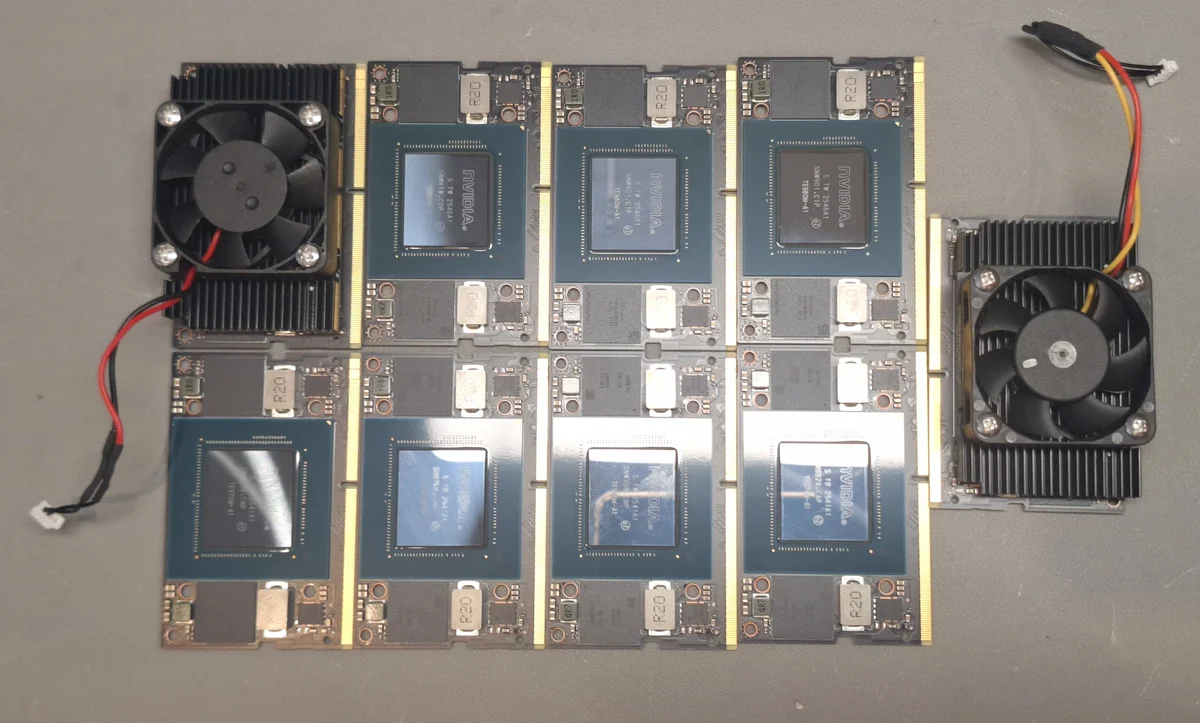
Our AI approach is to deliver the full chain: custom carrier board, Yocto BSP, accelerated inference pipeline and hardware-in-the-loop tests, rather than a stack of software bricks. In our practice, this is what separates a lab proof of concept from an industrializable product. The cases above illustrate the potential of industrial AI; at AESTECHNO, we do not just talk about it, we deploy it.
Real-time video re-encoding project on a Jetson platform
We designed and deployed a complete solution for an industrial customer that required real-time re-encoding of high-resolution video cameras with live streaming. The challenge: capture several high-definition video streams simultaneously, re-encode them on the fly and broadcast them live, on a compact embedded system, with no cloud infrastructure, minimum latency and 24/7 reliability.
Our approach:
- Custom electronic board: design of a custom carrier integrating an NVIDIA Jetson module, adapted to the mechanical and thermal constraints of the field deployment.
- Custom Linux BSP: development of a complete Board Support Package: camera drivers, device tree, boot optimization, thermal management and the peripherals specific to the board.
- Accelerated live video pipeline: multi-camera high-resolution capture, hardware re-encoding via NVENC/NVDEC, and live streaming with controlled latency. All processing is local, with no cloud dependency.
- Complete integration: from board design to embedded software, including thermal validation, long-duration stability tests and industrialization readiness.
Result: an autonomous embedded system capable of re-encoding and broadcasting live high-resolution video streams, 24/7, with production-grade reliability.
Recent AI projects: Jetson Orin NX, high-power AI ASIC, LIDAR
Q1 2026, Jetson Orin NX with custom Yocto BSP. We delivered a complete project based on the Jetson Orin NX module: custom carrier board, fully tailored Yocto BSP, LPDDR4x integration and an optimized AI vision pipeline. A technically demanding project that consolidated our expertise on real-time inference at the edge.
Industrialization of a high-power AI ASIC. We supported a customer through the industrialization of an ASIC dedicated to high-power AI acceleration: PCB integration, thermal management, multi-phase power rails and production validation. When volumes and energy constraints justify it, dedicated silicon becomes more competitive than a Jetson module.
LIDAR, AI perception for advanced applications. We also led a complex LIDAR project, combining high-speed signal processing, sensor fusion and an AI perception chain. This field report feeds our approach on AI-augmented vision and perception applications. On a recent project, we noted that a properly sized edge AI pipeline cuts the five-year total cost of ownership by 40 to 60 percent versus an equivalent cloud flow, based on our comparative Jetson vs cloud GPU measurements.
Technologies we master
This project illustrates our distinctive positioning:
- Embedded AI platforms: NVIDIA Jetson (Nano, Orin), TPU integration (Google Coral)
- Hardware acceleration: CUDA, TensorRT, DeepStream for video processing and AI inference
- BSP and embedded Linux: Yocto, Buildroot, custom drivers, system optimization
- Hardware design: we do not stop at software, we design the board, write the BSP and integrate AI. From prototype to series.
How to make an industrial AI project succeed: methodology, governance and budget
The industrial AI deployment methodology is a four-step structured process: business analysis, technical specification, agile prototype and governed industrialization, that secures return on investment before going to production. It combines business strategy, system architecture, change management and data ethics. In our practice, the specification stage filters out 80 percent of risks. Below are the keys to an effective rollout that we apply at AESTECHNO.
1. Business context analysis
It all starts with a concrete problem: scrap rate, machine downtime, lost time, data overload, insufficient quality. An exploratory phase identifies the relevant AI levers, the data available (sensors, logs, history) and the customer constraints (real-time, offline, security). This step is part of our broader product design approach, where every technical decision is driven by the business need.
2. Technical specification
On this base, we define the following:
- Data sources (types, frequency, quality)
- Processing requirements (embedded ML, cloud, GPU, etc.)
- Integration into the existing environment (ERP, SCADA, MES)
- User or operator interfaces (dashboards, smart alerts, API)
3. Agile, iterative prototype
A proof of concept (PoC) is launched on one machine, line or process. The goal is to prove the AI value-add quickly. This phase covers:
- Real-data collection
- Custom model training
- Localized deployment with impact measurement (KPIs: time saved, errors avoided)
4. Deployment and governance
Once benefits are demonstrated, the project is industrialized with:
- Secured data processing (GDPR, encryption, partitioning), an issue we cover in our industrial IoT cybersecurity guide
- Technical scale-up (replication on several lines or sites)
- Team training: adoption, result interpretation, human-machine collaboration
- Continuous performance monitoring of the model (re-training, human supervision)
What budget should you plan?
The budget for an industrial AI project varies with complexity, data volume and the level of integration sought. The main cost categories are:
- Software development and data science (collection, labelling, training)
- Acquisition or adaptation of sensors and AI hardware
- User interfaces tailored to the industrial environment
- Change management and team training
- Certification when needed (medical, automotive, aerospace)
A targeted PoC quickly demonstrates the value-add before engaging in a large-scale rollout. Contact us to assess your project.
Sectors transformed by AI
A sector transformed by AI is an industry where artificial intelligence has moved from proof of concept to production line, notably energy, oil and gas, logistics and healthcare. According to analyses published by the OECD and research indexed on arXiv, predictive maintenance and in-line vision quality are the two use cases with the fastest ROI.
- Energy and wind: turbines monitored to anticipate failures, with a 30 percent drop in maintenance costs.
- Oil and gas: Schneider Electric monitors offshore oil and gas pumps via Azure-hosted AI to anticipate failures.
- Logistics and safety: 3 Men Movers (Texas) uses AI cameras to detect distracted driving and optimize routes, with 4.5 percent fewer accidents (Business Insider).
AI and the human factor: toward human-machine collaboration
The human factor in an AI deployment refers to all the interactions between operators, engineers, technicians and augmented systems, from acculturation to decision governance. According to work from Stanford HAI and MIT publications on AI at Work, projects that fail tend to fail on adoption first, not on technique.
AI integration only succeeds if it accounts for the human factor. Behind every automated process there are technicians, operators and engineers who will interact with these tools every day. The fear of replacement must be addressed: AI is not there to substitute the human, it is there to augment their capacity to act, to free time for what the machine cannot do, namely understanding context, judgement, innovation and dialogue.
This requires progressive acculturation. Train teams to interpret model predictions, to dialogue with augmented systems (smart dashboards, industrial voice assistants, automated alerts) and to make AI-supported decisions. It also implies trust in the systems: algorithm transparency, decision traceability, ability to understand "why" an AI proposes an action. Finally, this transition needs clear governance: who validates models, who updates them, who arbitrates in case of doubt?
AI is therefore a catalyst for skill ramp-up, not a threat. By relieving operators of painful or routine tasks, it opens the door to a more human industrialization, where humans keep their hand on meaning and intent while the machine helps them explore complexity.
Bottom line
- Embedded industrial AI is now a measurable production reality: 20-100 ms latency on Jetson Orin NX with no cloud round-trip, 4 TOPS at less than 2 W on Coral, 99.5 percent accuracy on document processing in field deployments.
- INT8 quantization is the single highest-impact optimization: a 4x cut in size and energy for under 1-2 percent accuracy loss, validated by NVIDIA, Hugging Face and Google DeepMind on modern convolutional architectures.
- The right accelerator is the one that fits the energy budget, not the one with the most TOPS: MCU + Ethos-U for sub-10 mW sensors, Coral or Myriad X for under 2 W cameras, Jetson Orin NX for multi-camera vision pipelines.
- Regulatory framework is not optional: EU AI Act 2024/1689, ISO/IEC 42001, IEC 62443 for OT cybersecurity, IEEE 7000 ethics, all gate the industrialization of AI on production lines.
- The full chain matters: carrier board, Yocto BSP, accelerated inference pipeline, hardware-in-the-loop tests, in-house power profiling with TekExpress and Nordic PPK2, all the way to industrialization.
Do you have a high-performance electronic product project that needs AI?
Contact us for a free feasibility study or a technical audit of your concept. AESTECHNO has already delivered projects based on NVIDIA Jetson compute modules.
Industrial AI project? Let us discuss it.
You are a decision-maker, CTO or project manager and you want to integrate AI into your processes or products? At AESTECHNO, we support you from feasibility study to industrialization:
- Hardware design tailored for AI (Jetson, TPU, MCU + AI)
- Embedded ML algorithm development
- Sensor integration and data processing
- Industrialization and CE/FCC certification
Book your free 30-min AI audit
Or write to us directly: contact@aestechno.com
Why choose AESTECHNO?
- 10+ years of expertise in embedded electronics
- 100 percent success on CE/FCC certifications
- 65 projects delivered since 2022
- Jetson and TPU platforms integrated successfully
- French electronic design company based in Montpellier
Article written by Hugues Orgitello, electronic design engineer and founder of AESTECHNO. LinkedIn profile.
FAQ: industrial and embedded AI
How long does it take to deploy a first industrial AI project?
A proof of concept (PoC) can be carried out in a few weeks to a few months depending on complexity. The goal is to validate feasibility and ROI quickly on a restricted scope (one machine, one line) before engaging in a wider rollout. At AESTECHNO, we recommend starting small, measuring results and then industrializing.
Should you choose between cloud AI and embedded AI (edge AI)?
Not necessarily. Cloud AI offers unlimited compute and complex models, but requires permanent connectivity and implies high latency (100-500 ms). Edge AI enables local on-device inference, with ultra-low latency (<10 ms), offline operation and data that stays local. Many projects combine both: edge for real-time, cloud for training and historical analysis. The choice depends on your constraints: latency, confidentiality, connectivity and budget.
What are the risks of an industrial AI project and how to control them?
The main risks are: insufficient or low-quality data, models that do not generalize in production, team resistance to change and underestimated integration budget. To control them: start with a PoC on real data, involve operators from the start, plan a training phase and pick a partner that masters both hardware and software to avoid integration issues.
Which processors should you use for embedded AI: GPU, TPU, NPU or MCU?
Classic MCUs (Cortex-M): simple inference (basic classification), models <100 KB, minimal consumption. AI MCUs (Cortex-M55 + Ethos-U): light neural networks, 10-50 GOPS, <10 mW. Embedded GPUs (NVIDIA Jetson): 20-275 TOPS, complex models, 10-60 W. Google TPU (Coral): 4 TOPS, peak efficiency, TensorFlow Lite models. Dedicated NPUs (Intel Movidius): performance-consumption trade-off.
How to optimize an AI model for embedded (edge deployment)?
Main techniques: quantization (FP32 to INT8/INT16, 4x cut in size and compute), pruning (removal of low-weight connections, 50-90 percent cut), knowledge distillation (large model to small model), efficient architectures (MobileNet vs ResNet). Tools: TensorFlow Lite, ONNX Runtime, PyTorch Mobile, TensorRT (NVIDIA). Essential validation: check post-compression accuracy (under 1-2 percent degradation is acceptable).
Should you build an AI solution in-house or with a specialized partner?
It depends on your internal skills and the nature of the project. If your AI requires specific hardware (sensors, embedded boards, accelerators), a partner that masters the full hardware + software + AI chain reduces integration risks and accelerates time to market. An electronic design firm like AESTECHNO designs the board, writes the BSP and integrates AI, which avoids coordinating multiple suppliers.
What budget should you plan for an embedded AI project?
The budget depends on several factors: AI model complexity (simple classification vs real-time vision), hardware choice (MCU with accelerator, TPU, embedded GPU like Jetson), volume of data to collect and label, and certification requirements (medical, automotive). A PoC validates feasibility at lower cost before investing in industrialization. Contact AESTECHNO for a tailored estimate suited to your context.
Related articles
To go further on embedded AI and intelligent systems:
- Predictive maintenance IoT, concrete AI applications for industrial monitoring and ROI
- Electronic design services methodology, our complete approach from spec to certified product
- Industrial IoT cybersecurity, securing embedded AI systems: model, data and communication protection
- Embedded power management, sizing the power tree for AI accelerators and battery devices
- AESTECHNO blog, more in-depth articles on hardware, firmware, RF and AI integration